Click here to sign up for our free daily newsletter
(Image Credit: North Battleford Downtown Business Improvement District (BID))
Air quality

Provincial study targets North Battleford air-monitoring gap

Aug 20, 2026 | 12:11 PM

When wildfire smoke or other pollution moves into North Battleford, residents do not have a permanent local monitoring station measuring the air they are breathing.

A provincial study underway this summer could help determine whether that should change.

The Saskatchewan Ministry of Environment identified North Battleford as a gap in the province’s air-quality monitoring network after looking at industrial emissions, current air-quality conditions, population and the distance to nearby stations.

North Battleford has been monitored before. 

Kathryn Turner, a senior air quality specialist with the province’s Environmental Protection Branch, said the province collected air-quality data in the city in the early 2000s, but later moved the equipment elsewhere because local air quality was generally very good and monitoring resources were limited.

She said the province is taking another look because North Battleford is a population centre where local air-quality information could be useful to residents making health decisions.

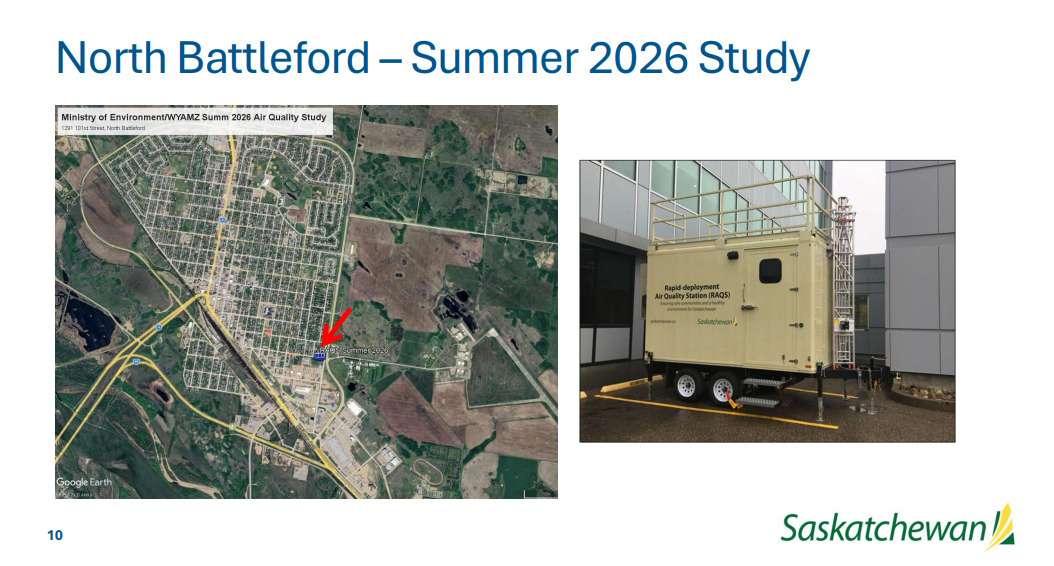
A temporary monitoring station has been operating on city property south of Territorial Drive this summer. The study is intended to provide a better picture of the air people experience in North Battleford and determine whether longer-term monitoring would be beneficial.


(Image Credit: Ministry of Environment)

That information can become particularly useful during wildfire smoke events.

Turner said fine particulate matter, known as PM2.5, is the primary component of wildfire smoke and can affect areas both close to and far away from fires.

“PM 2.5 are particles that are small enough to pass through the lungs into the bloodstream and can sometimes contain toxic materials such as heavy metals,” she said.

Air-quality measurements can also be used to calculate the Air Quality Health Index, or AQHI, which gives the public a measure of health risk based on nitrogen dioxide, ground-level ozone and particulate matter.

Turner said the index ranges from one to 10 and above, with recommendations changing as conditions worsen, including whether people should reduce or reschedule outdoor activities.

The province is monitoring pollutants that can come from several sources around North Battleford, including wildfire smoke, power generation, vehicles, residential and institutional heating and the surrounding oil and gas industry.

The study does not mean officials have identified an air-pollution problem in the city. Rather, it is intended to provide current local data where the province says a monitoring gap exists.

The project is fully funded by the Ministry of Environment through its annual mobile-monitoring program. Turner said the province uses the program both to support compliance work and to investigate areas where more information about air quality is needed.

The study is expected to wrap up in September, with results available before December. 

The results are expected to be shared with city council, the Western Yellowhead Air Management Zone and government officials.

Council could also have another decision to consider once the results are available.

The Western Yellowhead Air Management Zone invited North Battleford to consider becoming a member, which would give the city an opportunity to participate more directly in regional air-quality monitoring and public engagement. 

Council asked administration for more information about what membership would involve, with officials suggesting the discussion could return around December.

Kenneth.Cheung@pattisonmedia.com