Click here to sign up for our free daily newsletter
Dr. Joseph Blondeau says in Saskatchewan humans are typically exposed to hantavirus through contact with rodents or rodent droppings. (Image Credit: ID 235075451 © Michael Siluk | Dreamstime.com)
'I think our risks are very, very low'

Cruise ship hantavirus cases not a threat to Saskatchewan residents: expert

May 11, 2026 | 2:39 PM

A recent hantavirus outbreak aboard a cruise ship anchored near the Canary Islands is not a cause for concern in Saskatchewan, according to a provincial microbiologist.

Dr. Joseph Blondeau, a clinical microbiologist and head of clinical microbiology at Royal University Hospital and the University of Saskatchewan, said the situation involving the cruise ship is an unfortunate but isolated event tied to exposure outside the province.

“I don’t think so,” Blondeau said when asked whether people should be concerned. “I think what we’re looking at here was a really unfortunate situation where a couple of individuals happened to go to an endemic area where the vector, or the rodent which carries this particular virus, is known to exist.”
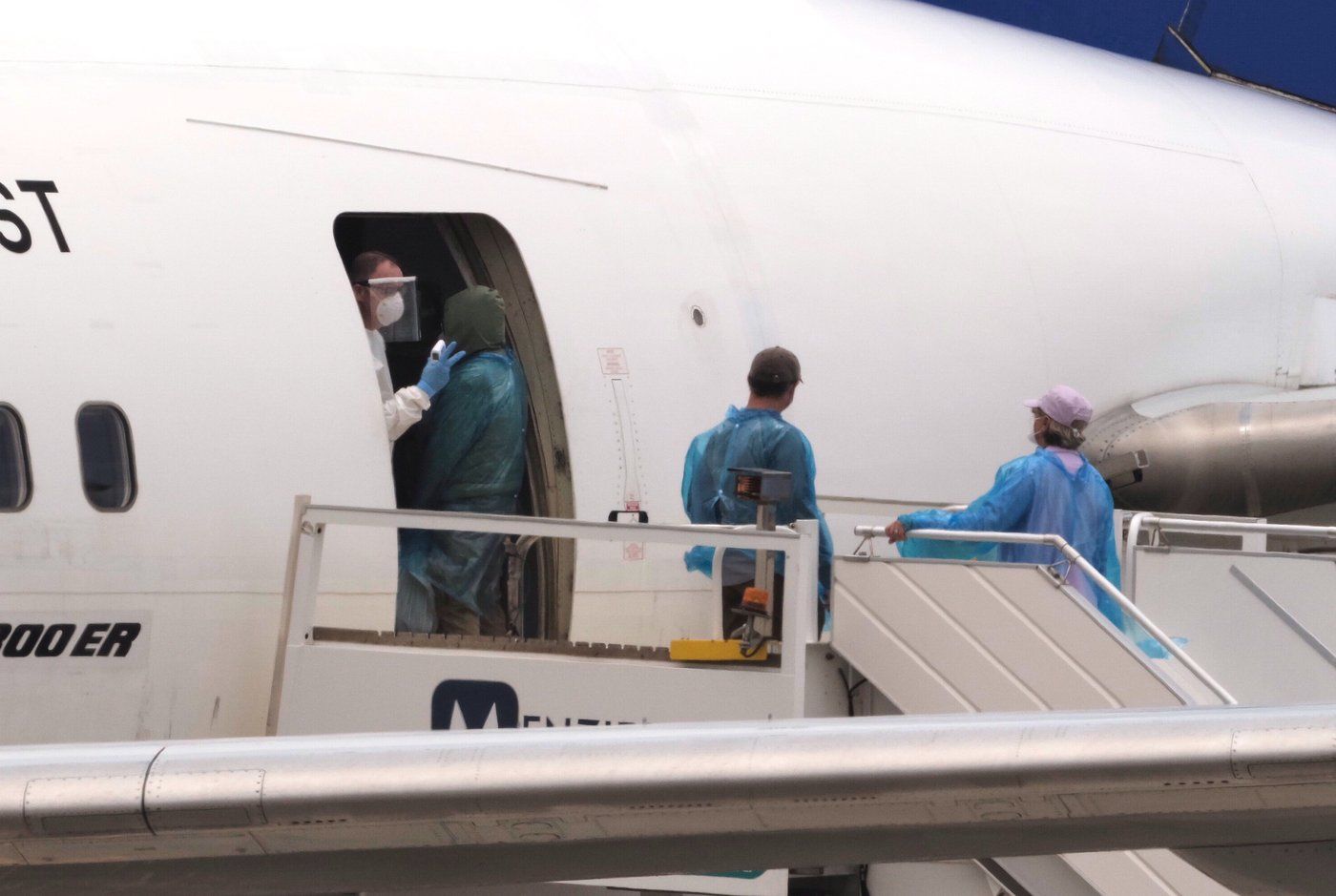
Passengers board a plane bound for Canada, after disembarking from the hantavirus-stricken cruise ship MV Hondius at the airport in Tenerife, Canary Islands, Spain, Sunday, May 10, 2026.
Passengers board a plane bound for Canada, after disembarking from the hantavirus-stricken cruise ship MV Hondius at the airport in Tenerife, Canary Islands, Spain, Sunday, May 10, 2026. (Image Credit: AP Photo/Arturo Rodriguez)

Two passengers tested positive for hantavirus, while a third showed symptoms following the cruise. Blondeau said it appears the individuals were exposed before boarding the ship.

The strain involved in the cruise ship cases is different from the hantavirus found in Canada. Blondeau noted that around the world, there are 38 different strains, but only one has been associated with human-to-human transmission, and even that occurs under very specific conditions.

“The hantavirus that we have here in Canada is not,” he said. “And even that association is under circumstances of a very, very close contact.”

Saskatchewan Chief Medical Health Officer Dr. Saqib Shahab echoed that message.

“The type we see in Saskatchewan does not transmit from person to person. It transmits from rodents to humans,” Shahab said. “The situation on the ship was a very different situation from what we historically see in Saskatchewan.”

Shahab added provincial health officials are not aware of any direct connection to Saskatchewan.

“As of this date, we are not aware of any passengers or other contacts from the ship in question who have arrived or are arriving in Saskatchewan,” he said.

In Saskatchewan, hantavirus pulmonary syndrome (HPS) is rare but serious. According to provincial data, 38 cases have been reported between 1994 and 2025, with 12 resulting in death. The illness is primarily spread through exposure to infected deer mice, particularly their urine, feces or saliva.

“Hantavirus is a virus which is commonly found in rodents,” Blondeau said. “And in this province, in Saskatchewan, we see it in deer mice and rice rats and white-footed mice, cotton rats, etc.”

People most often become infected when virus particles become airborne during activities such as cleaning rodent-infested barns, sheds or garages.

“If you start sweeping this stuff up, then the virus can become aerosolized. You inhale it, and then you can become infected,” Blondeau said.

Shahab urged residents to take precautions when opening seasonal properties and outbuildings this spring.

“If they’re opening up their sheds and barns and cottages, leave the windows open for at least 30 minutes,” Shahab said. “Try not to use dry mopping methods that can generate an aerosol that you may breathe in — use wet mopping methods.”

Early symptoms of HPS are flu-like and can include fever, headache, muscle aches and fatigue, before progressing to severe respiratory distress in some cases. Blondeau said the incubation period can range from one to several weeks, making exposure difficult to trace.

Despite the seriousness of HPS, Blondeau stressed that the disease remains extremely rare.

“When we look at the population sizes in western Canada, and we look at the rodent population and our interactions, or potential interactions, this is a very, very rare infection indeed,” he said.

He encouraged residents to continue taking precautions when cleaning enclosed spaces, including using bleach solutions, wearing protective equipment and avoiding sweeping or vacuuming.

“I think if we do what we’ve always been doing in this province, and being careful when we’re cleaning our sheds and barns and whatnot, then I think our risks are very, very low,” Blondeau said.

-With files from CKOM

(This article was updated at 3:25 p.m. to include comments from Saskatchewan’s Chief Medical Health Officer Dr. Saqib Shahab.)

panews@pattisonmedia.com