Click here to sign up for our free daily newsletter
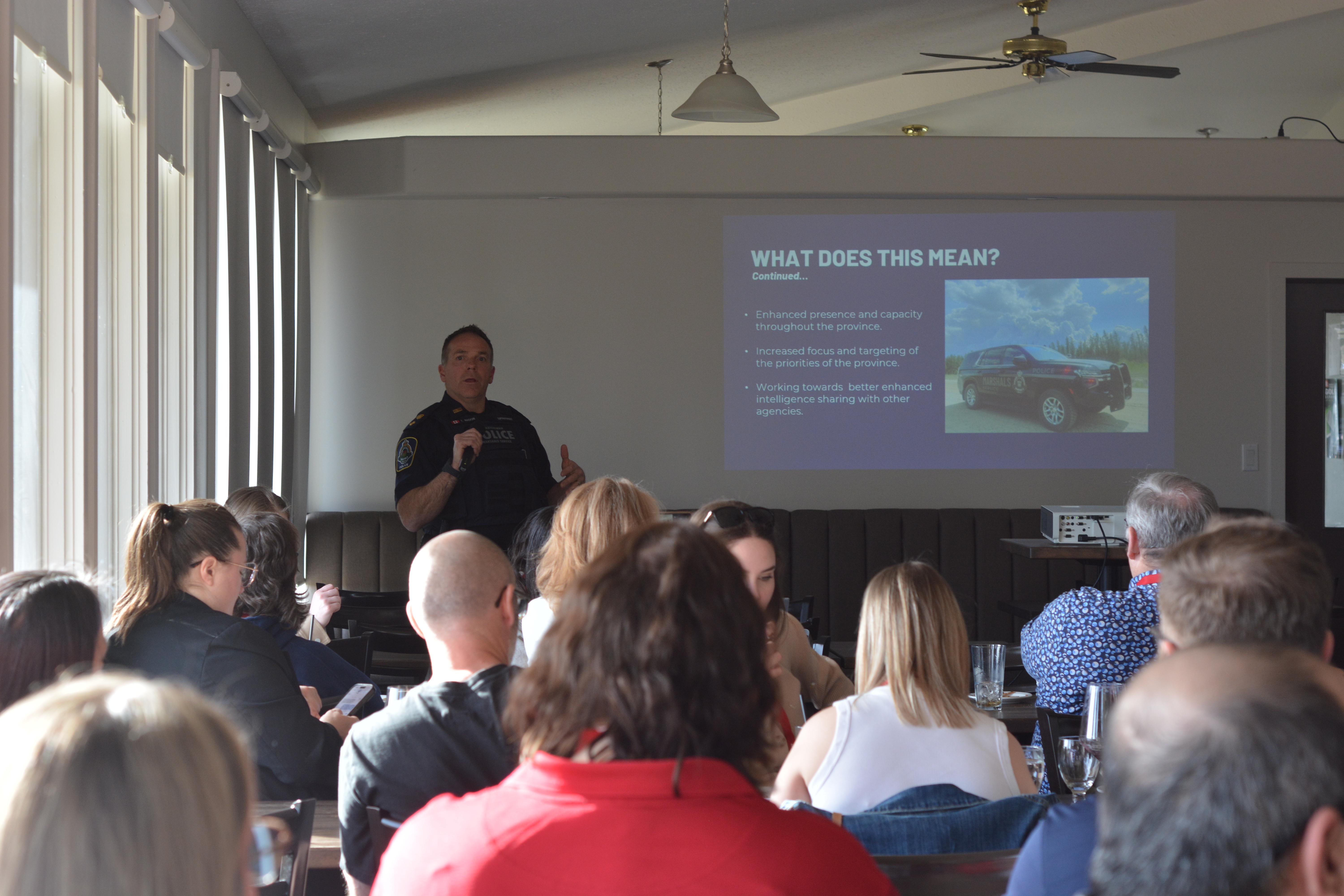
Inspector Joey Lalonde of the Saskatchewan Marshals Service speaks during a Battlefords Chamber of Commerce event at Blend Riverside in North Battleford on April 30, 2026. (Image Credit: Kenneth Cheung/battlefordsNOW)
public safety

New marshals unit targets repeat offenders in the Battlefords

May 1, 2026 | 5:05 PM

A provincial policing unit operating in the Battlefords is focusing on arresting people with outstanding warrants, targeting offenders police say have often been difficult to track.

“If you consider individuals that have warrants, they can walk the streets, they can drive vehicles, they can continue to do crime without being detected if no one’s actively looking for them,” said South Region Superintendent Tony Nadon.

The Saskatchewan Marshals Service (SMS), a provincial police agency created to support existing forces, is focusing much of its work on locating and arresting those individuals.

“So Saskatchewan has a large number of outstanding warrants of individuals who are not being looked for. They’re not being sought after,” Nadon said.


“And that’s what we’ve been doing, we speak to the police jurisdiction. They provide us a list of their warrants.”

READ MORE: ‘It’s a battle’: Battlefords’ top Mountie says repeat offenders straining policing

South Region Superintendent Tony Nadon of the Saskatchewan Marshals Service speaks during a Battlefords Chamber of Commerce event at Blend Riverside in North Battleford on April 30, 2026.
South Region Superintendent Tony Nadon of the Saskatchewan Marshals Service speaks during a Battlefords Chamber of Commerce event at Blend Riverside in North Battleford on April 30, 2026. (Image Credit: Kenneth Cheung/battlefordsNOW)

Unlike RCMP or municipal police, marshals are not the police of jurisdiction and do not respond to 911 calls.

“Unless the police jurisdiction gives us a call and says, ‘Hey, we need assistance with this,’” Nadon said.

Inspector Joey Lalonde said that distinction is key to how the unit operates.

“When you get overrun by responding to calls, sometimes all of the really good work that you did to get that warrant on the system, you no longer have the opportunity to spend the time to research that individual, find them wherever they are,” he said. “And so that’s how we really hope to bring value back to the RCMP.”

The service, which falls under the Saskatchewan Police Act, is authorized for up to 70 officers provincewide, with its provincial headquarters in Prince Albert.

In North Battleford, the province’s first regional headquarters, a team of five marshals is currently operating, with plans to expand to about 19 officers locally as the unit builds toward its full complement by 2027.

Despite its small size, the team has already begun making an impact. 

“Even just today [April 30], we have a small, very small team of marshals here in North Battleford, and they effectively arrested three individuals with a number of outstanding warrants,” Nadon said.


(Image Credit: Kenneth Cheung/battlefordsNOW)

The focus is on prolific and high-risk offenders, including those tied to violence, weapons and drug activity, as well as people breaching court-ordered conditions.

Lalonde said marshals are also monitoring offenders released into the community.

“Actually going to their homes on a regular basis to make sure they’re monitored changes the reality for them of like, ‘Hey, people are actually showing up now to make sure I’m doing these things,’” he said.

“That was definitely a gap that I knew existed.”

The service is also working with First Nations through agreements such as band council resolutions, allowing marshals to operate on reserve land at the request of local leadership.

“We’ve been engaging a lot of First Nations communities and signing agreements with them,” Nadon said. “So if they’re having concerns with certain individuals or certain events, we can go and assist them.”

Red Pheasant Cree Nation is one example – the first First Nation in Saskatchewan to sign an agreement with the service – where officers are already active following the deal.

“We actively go out there and patrol. We actively go out there and assist the band council with concerns that they have,” Nadon said.

He said the approach is based on collaboration, with Chiefs and councils identifying issues and requesting support where needed.

As a provincial unit, marshals can be deployed anywhere in Saskatchewan to assist with major incidents, including serious crimes, natural disasters and emergencies, at no direct cost to municipalities.

Lalonde said the goal is to build on those partnerships.

“We’re only almost five months into this program here, and we are making a difference,” he said.

“We’re talking to a lot of stakeholders and community members who are seeing what we’re doing.”

READ MORE:

‘A historic day’: Red Pheasant becomes first Sask. First Nation to sign MOU with Marshals Service

Meet Teddy Munro, the First Nation officer shaping Saskatchewan’s Marshals Service

Kenneth.Cheung@patisonmedia.com