Click here to sign up for our free daily newsletter
(Image Credit: ID 443554064 © Evgdneprua | Dreamstime.com)
COST OF LIVING

‘It’s a difficult time for us’: Battlefords food bank cuts hampers as Saskatchewan grocery inflation tops Canada

May 8, 2026 | 3:50 PM

As Saskatchewan records the highest food inflation rate in Canada, the Battlefords food bank says demand for children’s food bags has nearly doubled compared with a year ago.

The Battlefords District Food and Resource Centre distributed 670 Food for Kids bags in March, up from 352 during the same month last year, executive director Erin Katerynych said.

“Like, that was a massive jump for March,” she said.  “As an organization with no core funding, it’s a difficult time for us.”

Katerynych said the food bank helped more than 1,800 people in March as rising grocery costs continue putting pressure on families.

“The foods that we use for the Food for Kids have really gone up in price, like they have more than doubled,” she said. “I’m now purchasing product that is on sale for more than it was regular price a couple years ago.”

The organization has reduced what goes into hampers and children’s food bags to stretch supplies further.

“We’ve cut back on what we’re distributing in our food hampers themselves so that we are able to help everybody,” Katerynych said.

READ MORE: Inflation impacting non-profit operations

She said staff are also noticing more people walking to the food bank as fuel prices rise.

“A lot of people are walking more so these days than they were before because they just can’t afford the price of gas,” she said.

Katerynych added that donations have also slowed as households face growing financial pressure.

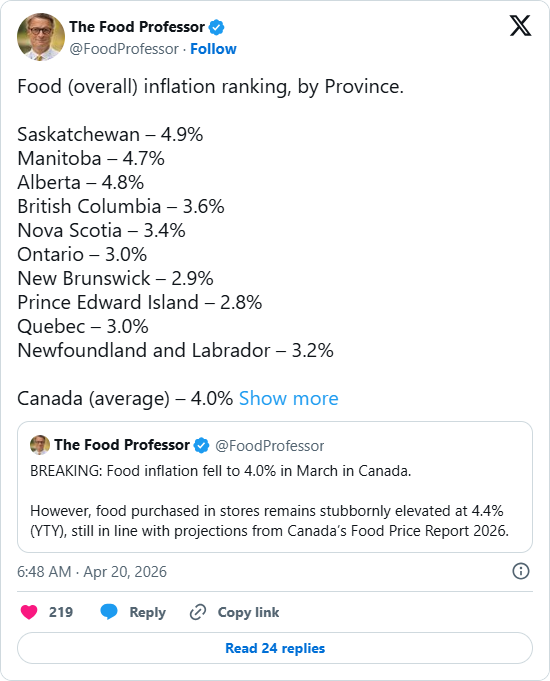
According to figures shared by Sylvain Charlebois, director of the Agri-food Analytics Lab at Dalhousie University in Halifax, Saskatchewan recorded the country’s highest food inflation rate in March at 4.9 per cent.

Alberta followed at 4.8 per cent and Manitoba at 4.7 per cent, while Prince Edward Island recorded the lowest rate at 2.8 per cent.


(Image Credit: The Food Professor/ X)

Charlebois said rising food prices in Saskatchewan largely mirror trends seen elsewhere in Canada, particularly in produce and meat.

“If you look at what’s up in Saskatchewan, it’s mainly the same thing as other places in Canada. And that would be produce and meat products,” he said.

“Chicken has been a bit of an issue for Saskatchewan. Chicken prices have gone up for all Prairie provinces —the one thing that we’ve noticed is that out west, quotas haven’t been matched in terms of production for several cycles, and that tends to push prices higher.”

He said that a lot of increases can likely be attributed to a change in procurement.

“My guess is that grocers had to procure these foods elsewhere and farther than the U.S., and with fuel charges, my guess is that it just added up,” he said.

“… because we’re procuring food differently, prices were impacted as a result one year later. So I think that’s what’s going on right now.”

With demand continuing to climb, Katerynych said the food bank is asking the community to help through food donations, fundraising efforts or financial support.

“This community is absolutely amazing, and anytime we need help, the community has always stepped up and lent us a hand,” Katerynych stated. 

-With files from 650 CKOM

Kenneth.Cheung@pattisonmedia.com