Click here to sign up for our free daily newsletter
(Image Credit: Lisa Schick/980 CJME)

Abacus poll finds cost of living is top concern as NDP, Saskatchewan Party nearly tied 

Oct 22, 2026 | 1:00 PM

If a provincial election were held tomorrow, a new Abacus Data poll shows the provincial NDP virtually tied with the Saskatchewan Party.

The results, released Thursday, are the first from a new quarterly survey Abacus said will regularly track public opinion, political attitudes and issues in Saskatchewan. The company said this is the first of three reports it plans to release over the next few days as it expands its coverage of the province. 

“There’s a lot going on in Saskatchewan right now, particularly when you look at the economy and what is happening with resources,” said Curtis Brown, Abacus Data’s vice-president for Western Canada. 

Brown said he was not surprised by the results, including the close race between the Saskatchewan Party and the NDP. Among decided voters, the parties had 48 and 46 per cent support, respectively, while six per cent supported other parties not represented in the legislature. 
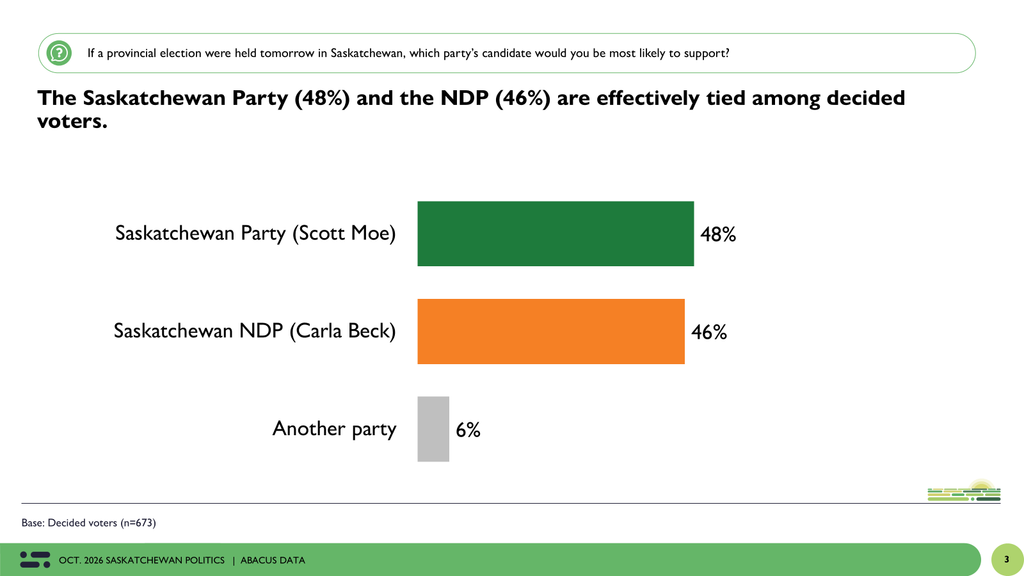

(Image Credit: Abacus Data)

The NDP led in Saskatoon with 62 per cent support to the Saskatchewan Party’s 34 per cent, and in Regina with 54 per cent to 41 per cent. The Saskatchewan Party held a smaller lead across Moose Jaw, Prince Albert, Swift Current, Yorkton and North Battleford, with 54 per cent support to the NDP’s 45 per cent. 

“The Saskatchewan Party has been in power for almost 20 years,” Brown said. “There comes a point when some people may want change, even if they have supported the party in the past or think it has done a good job overall.” 

Half of the 1,000 Saskatchewan residents surveyed said it was time for a change. That included 32 per cent who said the Saskatchewan Party government had done a poor job and 18 per cent who said it had done a good job but still wanted change. Another 31 per cent said the government had done a good job and deserved re-election, while 19 per cent were unsure. 

The NDP led among every age group under 60, while the Saskatchewan Party held a 65-to-32-per-cent advantage among respondents aged 60 and older. 

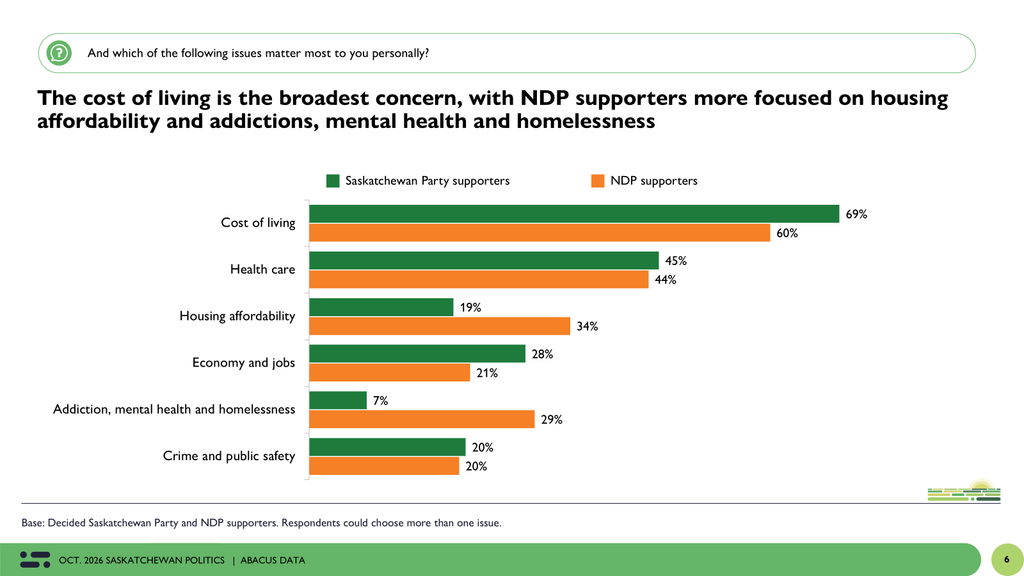
Cost of living was the broadest concern, cited by 63 per cent of respondents, followed by health care at 42 per cent. Housing affordability, the economy and jobs, addictions, mental health and homelessness, and crime and public safety were each named by more than one in five respondents.


(Image Credit: Abacus Data)

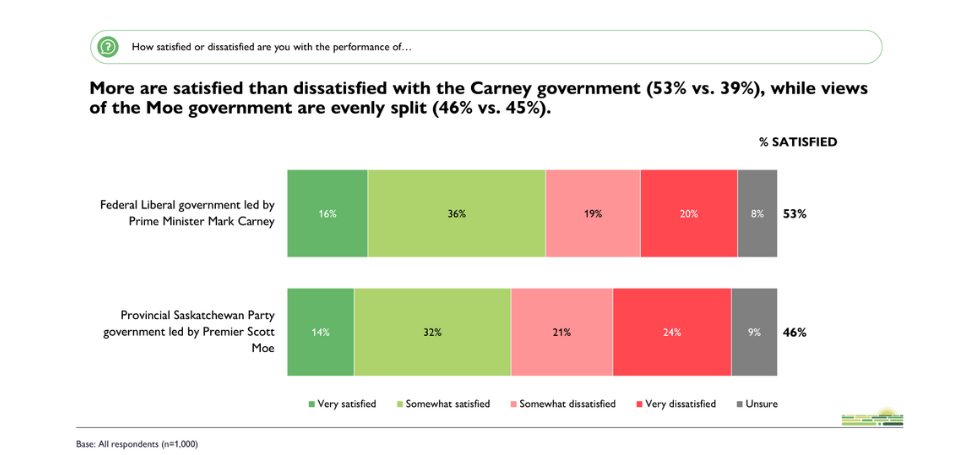
On government performance, 53 per cent of respondents said they were satisfied with Mark Carney’s federal Liberal government and 39 per cent were dissatisfied. Satisfaction with Scott Moe’s Saskatchewan Party government stood at 46 per cent, while 45 per cent were dissatisfied. 


(Image Credit: Abacus Data)

Respondents had similar positive impressions of Saskatchewan Party Leader Scott Moe and NDP Leader Carla Beck, at 48 and 47 per cent, respectively. Beck had a higher net favourability rating, at plus 13 compared with Moe’s plus seven, although 19 per cent said they did not know enough about Beck to rate her. Moe was more likely to be seen as best able to stand up for Saskatchewan with Ottawa and manage the economy, while Beck led on health care. Neither leader had an advantage on cost of living. 

Brown said Abacus plans to release more Saskatchewan polling as the next provincial election approaches and voters pay closer attention to the close race. 

“We have survey results all the time about federal issues and voting intention,” Brown said. “But in Saskatchewan, there has been a big gap, so we’re looking to fill it — not only by reporting the horse-race numbers, but by digging into the issues that are important.” 

The online survey of 1,000 Saskatchewan adults was conducted between Oct. 5 to 13. Abacus Data said respondents were recruited from a random sample of panelists and the results were weighted by comparison to census data. Because the sample was drawn from an opt-in panel, a conventional margin of error cannot be assigned. 

Because the NDP holds strong leads in Regina and Saskatoon, Brown said smaller cities could become important electoral battlegrounds. 

“Places like Prince Albert are going to be especially important and competitive,” Brown said. “They could make the difference between whether the NDP wins enough seats to form government or the Saskatchewan Party holds on to its support.”

—

susan.mcneil@pattisonmedia.com