Click here to sign up for our free daily newsletter
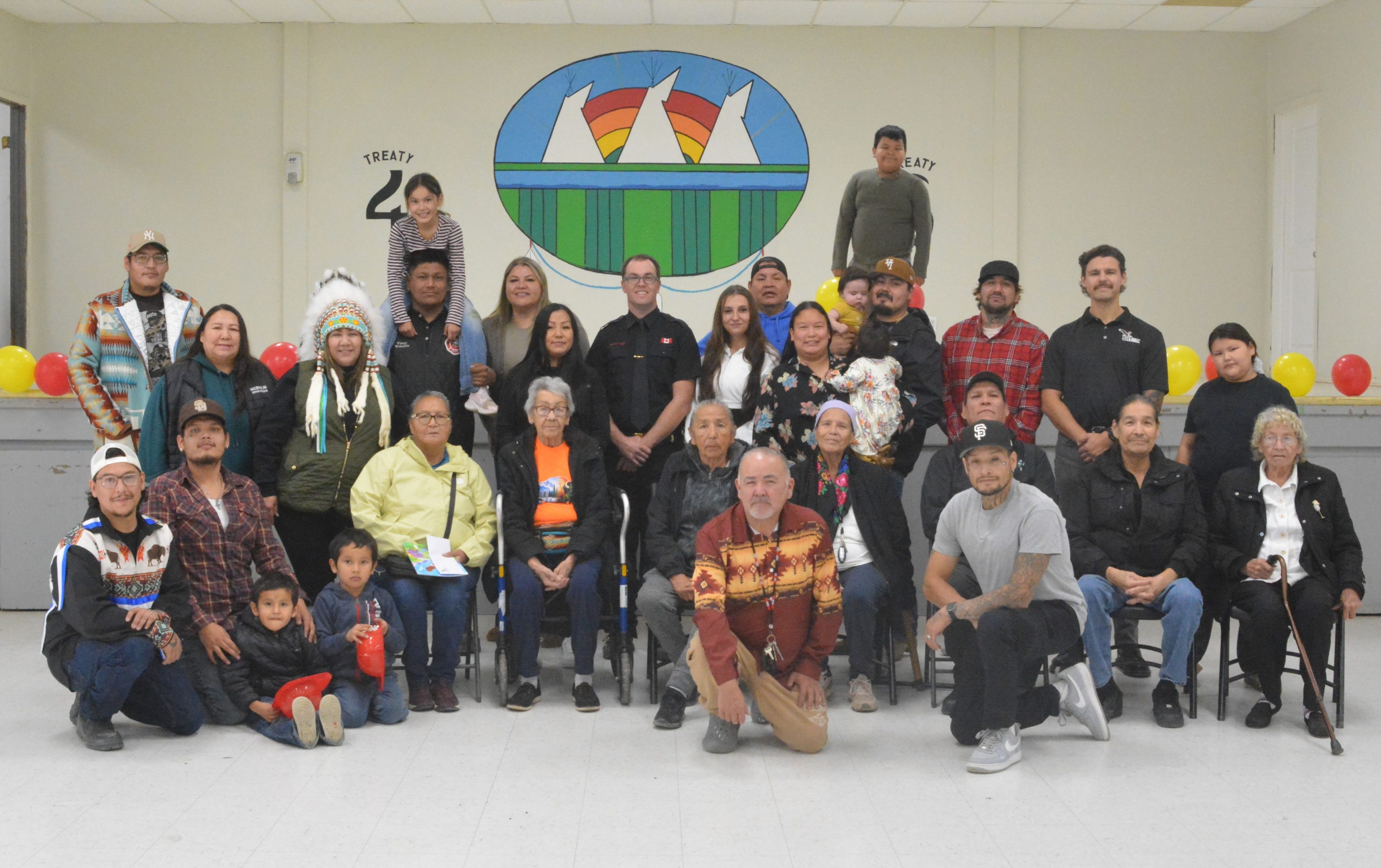
Volunteer firefighter graduates and community members gather at Mosquito Grizzly Bear’s Head Lean Man First Nation on Oct. 13, 2026, to celebrate the completion of a three-week Level One training program. Funded by SIIT, the program trained 13 volunteers to strengthen the community’s fire protection. (Image Credit: Kenneth Cheung/battlefordsNOW)
public safety

‘A sense of security’: Newly trained volunteers bolster MGBHLM First Nation’s fire protection

Oct 14, 2026 | 5:55 AM

Thirteen newly trained volunteer firefighters are bolstering fire protection at Mosquito Grizzly Bear’s Head Lean Man First Nation, where local crews now respond in about five minutes.

Coun. Celest Sanders said the community previously faced waits of roughly half an hour for firefighters from North Battleford.

“It’s a sense of security for our community that we can do this on our own and our people can be safer.”

The First Nation celebrated its graduates Oct. 13, after they completed a three-week Level One volunteer firefighter training program funded by SIIT.

“It feels nice to have more help. When we started here, there were just four of us. That was about seven years ago,” volunteer fire chief Vinny Wahobin said. 

He said the department lacked equipment and storage space in the past, for example, during a past eight-unit apartment complex fire on the First Nation.

“So we could save a lot more buildings, save a lot of lives, and save each other,” he said.

The Nation officially opened its $3.6-million fire hall in November 2025, which was fully funded by Indigenous Services Canada.  

READ MORE: MGBHLM First Nation opens $3.6M fire hall fully funded by Indigenous Services Canada

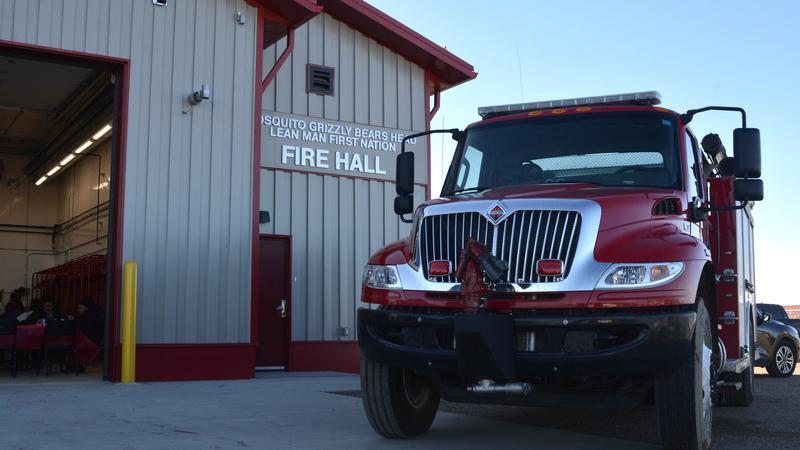
The new $3.6-million fire hall on Mosquito Grizzly Bear’s Head Lean Man First Nation (MGBHLM) is pictured on Monday, Nov. 3, 2025, following its official opening. The two-bay facility was designed by Associated Engineering and fully funded by Indigenous Services Canada (ISC).
The new $3.6-million fire hall on Mosquito Grizzly Bear’s Head Lean Man First Nation (MGBHLM) is pictured on Monday, Nov. 3, 2025, following its official opening. The two-bay facility was designed by Associated Engineering and fully funded by Indigenous Services Canada (ISC). (Image Credit: Kenneth Cheung/battlefordsNOW)

Sanders said the cost of outside fire responses helped drive the department’s development. About five years ago, she said, an outstanding bill was cited as a barrier when the community requested help.

She also credited North Battleford Fire Department with answering questions and sharing information about their operations as the community developed its service.

Sanders sought to bring the training to the community after enrolling in the program’s online course. 

“As soon as I got into chapter 3, I was like, we need this in the Nation. We need this for our people. It’s such a good program.” 

She said the community’s close ties can leave people feeling compelled to enter a fire to help friends or family members.

“Everybody wanted to help. When there’s a fire, everybody wants to pitch in, but a lot of people don’t have that training or that firsthand experience with fire.”

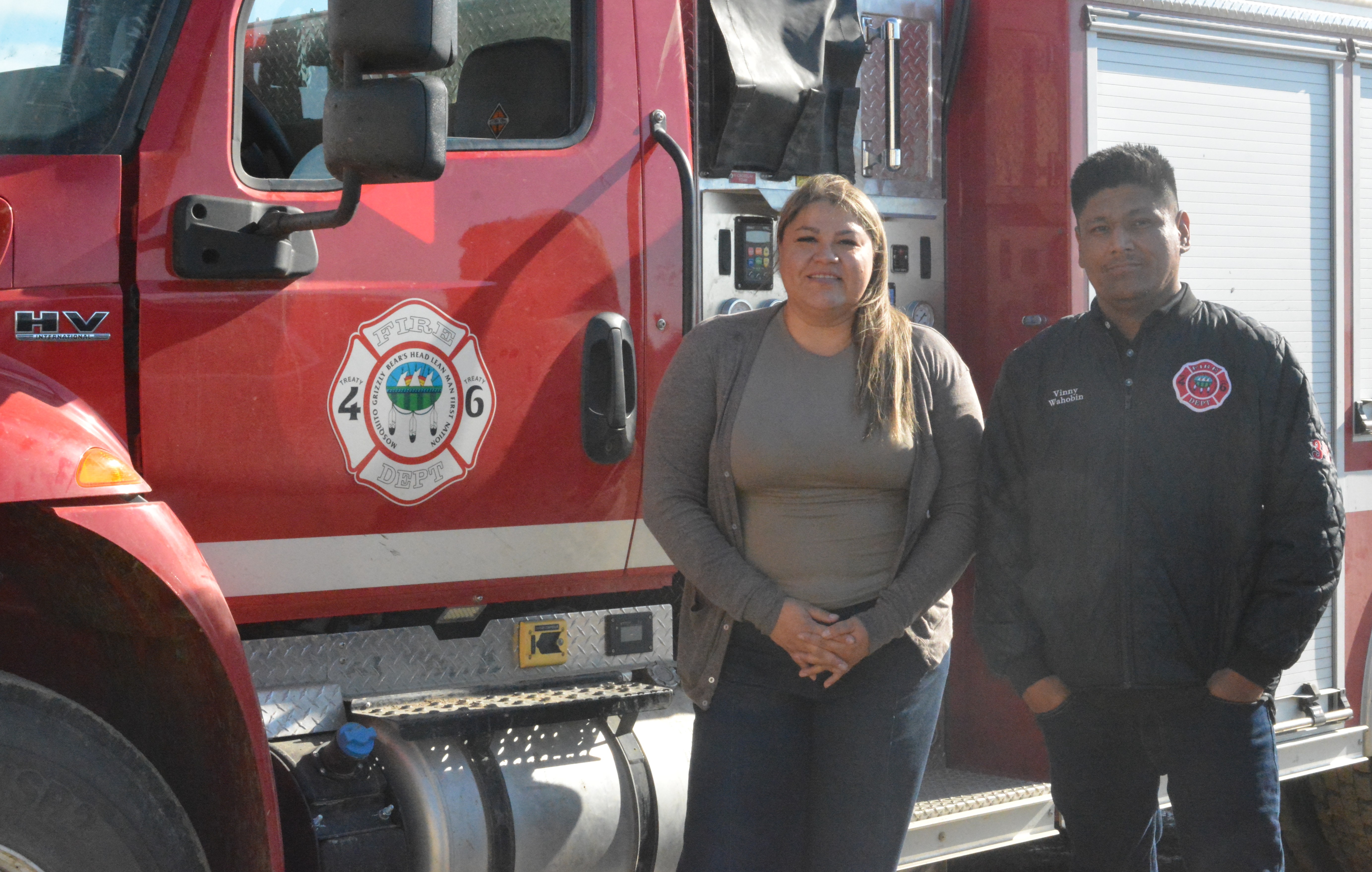
Coun. Celest Sanders and volunteer fire chief Viny Wahobin pose in front of the community’s fire truck at Mosquito Grizzly Bear’s Head Lean Man First Nation on Oct. 13, 2026, during celebrations for 13 volunteers who completed Level One firefighter training to strengthen local fire protection.
Coun. Celest Sanders and volunteer fire chief Viny Wahobin pose in front of the community’s fire truck at Mosquito Grizzly Bear’s Head Lean Man First Nation on Oct. 13, 2026, during celebrations for 13 volunteers who completed Level One firefighter training to strengthen local fire protection. (Image Credit: Kenneth Cheung/battlefordsNOW)

Instructor Kobie Guenther said SIIT and the Saskatchewan Volunteer Firefighter Association collaborated on the program.

Students learned to operate pumps and use protective equipment safely, including understanding its limits. The course also covered fire suppression, search and rescue, hazardous materials awareness and incident command.

During the second and third weeks, students practised scenarios at sites within the community, discussing situations that could arise and how to handle them safely.

Guenther said graduates would need continued practice and recommended Level Two training suited to the community’s needs.

“I hope this continues throughout the province to build a safe culture within the First Nations and other communities alike,” he said.

Volunteers have begun meeting on Tuesdays or Wednesdays to practise rope and ladder techniques, review pumps and maintain the fire hall, Sanders said. Wahobin said weekly sessions will also include drills for fighting fires in buildings and operating trucks.

The department also checks fire extinguishers and smoke alarms, creates fire breaks and plans controlled burns, he said.

Sanders said future plans include an on-call phone, a schedule and specialized training based on firefighters’ strengths. She also hopes firefighters could eventually provide first aid and some emergency medical services.

—

Kenneth.Cheung@pattisonmedia.com