Click here to sign up for our free daily newsletter
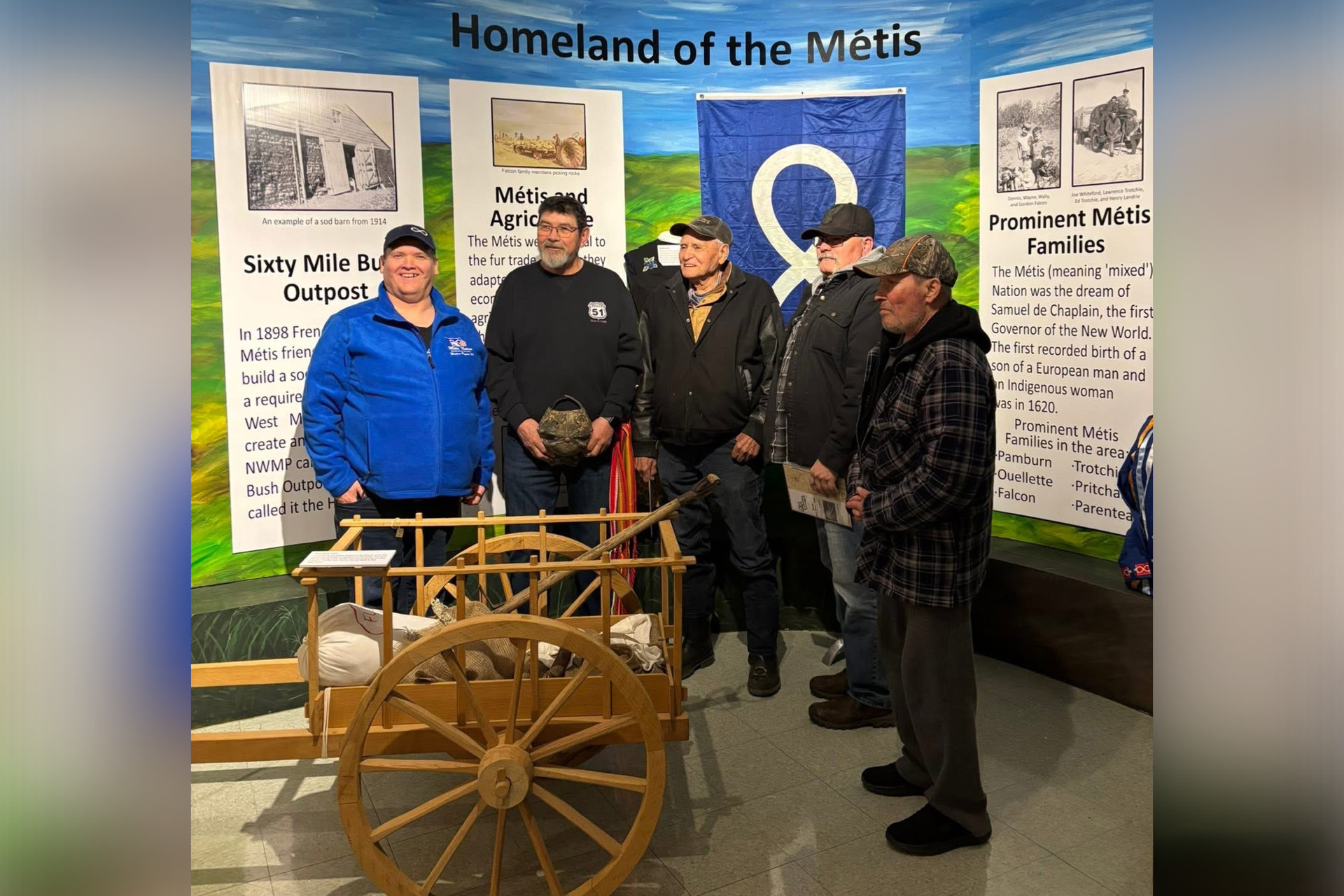
Members of the community gather in front of a full-sized Red River cart installed at the Gateway to Biggar during the grand opening of a new Métis exhibit over the weekend. (Image Credit: Lauri-Ann Falcon Larochelle/Facebook)
Local legacy

‘A wealth of knowledge’: New Métis exhibit at Biggar museum brings overlooked history into focus

Apr 27, 2026 | 3:53 PM

The wooden wheels don’t turn anymore, but they still carry a story.

At the Biggar Museum and Gallery, a new Métis exhibit is reshaping how local history is told, bringing long-overlooked contributions into focus through artifacts, photographs and a Red River cart now on display inside and at the town’s entrance.

The project grew out of a broader effort to recognize Métis and Indigenous histories that had not been fully represented in the museum’s earlier exhibits.

“It came about because we felt it was necessary to lead the settler history as not the prominent one,” said Delta Fay Cruickshank, the museum’s public program coordinator. 

“We wanted to involve the Indigenous and the Métis, and all had to do with truth and reconciliation.”  

The exhibit traces the role Métis people played in shaping the region, from early settlement to the transition from fur trade to agriculture. It also highlights local families and community connections that continue today.

Members of the community gather around a scale model Red River cart during the grand opening of a new Métis exhibit at the Biggar Museum over the weekend.
Members of the community gather around a scale model Red River cart during the grand opening of a new Métis exhibit at the Biggar Museum over the weekend. (Image Credit: Lauri-Ann Falcon Larochelle/Facebook)

Cruickshank pointed to the story of Frenchie Bernier, a trapper who built a shack south of present-day Biggar along a route used by settlers travelling between Swift Current and Battleford. While he is often remembered as the area’s first non-Indigenous settler, she said he relied on Métis support.

“It was he and his Métis friends that built the barn on his sod. And thus the beginning of the Métis being involved with helping the settlers.”  

Across the Prairies, Métis families helped clear land, worked fields and traded goods, while also guiding newcomers unfamiliar with the landscape and climate.

“They had the entrepreneurship of their white fathers and the knowledge of the land from their indigenous mothers. And to me, that is a wealth of knowledge,” Cruickshank said.  

The exhibit includes ribbon skirts, a capote made from Hudson’s Bay blankets, a Métis infinity flag and a scale model Red River cart provided by the Royal Saskatchewan Museum. A full-sized cart built by a local craftsman has also been installed at the town’s gateway.

Photographs of Métis families from the area form a key part of the display.

“We got photographs of people who live in the community, who are Métis, and a lot of people recognize them, because a lot of people are related to them,” said Christy McCafferty, the museum’s executive director.

“And it’s just that’s a solid connection to history. Is when you see somebody you know in an exhibit, and that really connects people to the history.”  

The project was supported through two grants, including funding for exhibit design training and a contribution from the Métis Cultural Development Fund. Museum staff and community members took part in developing the display.

McCafferty said the exhibit reflects the museum’s role in representing the full community.

“I feel like we are achieving what the museum is meant to do, which is represent the entire community,” she said. “People of Métis heritage are a large portion of the population of Biggar and should be represented.”  

For Cruickshank, the work is part of a broader shift in how the province’s history is understood.

“It’s time to embrace the history of the Métis and the Indigenous in Saskatchewan. Yes, most definitely. It’s time to embrace that,” she said.  

Kenneth.Cheung@pattisonmedia.com