Click here to sign up for our free daily newsletter
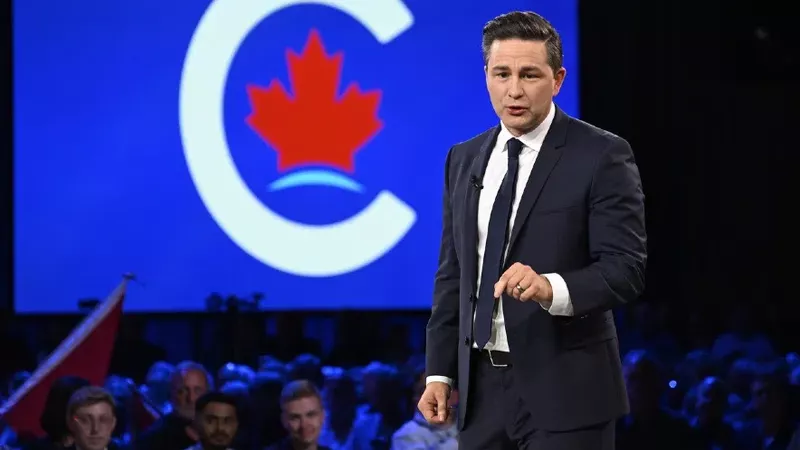
Conservative Leader Pierre Poilievre speaks to delegates at the Conservative party convention on Friday, Sept. 8, 2023, in Quebec City. (THE CANADIAN PRESS/Jacques Boissinot)
Federal Politics

Pierre Poilievre endorsed as Conservative leader by nearly 88 per cent of delegates

Jan 31, 2026 | 11:47 AM

Pierre Poilievre’s position as Conservative leader was cemented Friday after 87.4 per cent of delegates voted in a mandatory leadership review to keep him at the helm of their party.

The vote came after Poilievre spoke for more than 45 minutes at this weekend’s national convention in Calgary, flanked by supporters holding signs bearing slogans such as “real change” and “choose hope.”

He told Conservative supporters the theme of the convention was hope — and he promised not to give up as he asked delegates to give him another shot at leading the party into an election.

“Hope is the knowledge that your work will fulfil your purpose,” Poilievre said, becoming emotional as he spoke about being away from his young family and hoping to see his daughter Valentina, who has autism, speak for the first time.

He said young people in Quebec and Alberta can look forward to a country they can be proud of under a Conservative government — and placed the blame for rising separatist sentiment in those provinces at the feet of the federal Liberals.

Poilievre talked about uniting the country and offered to support Prime Minister Mark Carney’s government in its efforts to lower U.S. tariffs — but never mentioned President Donald Trump by name.

He did attack the Liberals for failing to bring about meaningful change since Carney was elected.

“Sure, the words have changed, the style has changed, but what’s changed in your life?” he asked.

A party of workers

Poilievre told supporters the Conservative party is the party of workers — including unionized workers — small business owners and young people.

He argued the Tories “won the debate” on the big issues in the last election campaign, such as crime, immigration, housing and taxation.

The crowd responded enthusiastically as he vowed the Conservatives would soon “be proven right once again on the wasteful and insane Liberal gun grab.”

The packed ballroom at Calgary’s BMO convention centre erupted in cheers and occasional chants of “Pierre, Pierre” as he spoke.

Still, the energy in the room was more subdued than it was during the rallies that became a signature feature of the Conservative election campaign.

Back in April, Poilievre was trying to convince Canadians to make him prime minister. On Friday, he was trying to convince Conservatives to keep him on as leader.

The last time the Conservatives held such a vote was in 2005, when Stephen Harper earned the support of 84 per cent of delegates.

Many of the Conservatives gathered in Calgary, including 21-year-old Jesse Affleck from New Westminster, B.C., said Poilievre has their full support.

“When I go to these events, he will shake the hands of every single person and have an actual conversation with every person,” he said.

Vincent Kunda said Poilievre’s message is what drew him to politics and he’s the right leader to take on the challenges posed by Trump.

“I voted for him in the last election because I put my vote and my faith behind him to handle Trump,” he said.

Not everyone was convinced. Susan Friedman, from the Ontario riding of Parry Sound—Muskoka, said she knows her opinion of Poilievre puts her in the minority.

“I was in Ottawa when he was elected. I didn’t support him then, and a lot has happened since then and it’s not good,” she said.

“I don’t think that he really can lead the party.”

Positive, optimistic message

Conservatives who oppose Poilievre often point to his sharp, aggressive tone and unwillingness during the election to pivot his campaign to confront Trump.

In Calgary, Poilievre clearly sought to send a more positive, optimistic message to Conservatives and the country at large.

Poilievre uncharacteristically admitted to a tactical error Friday evening, when he acknowledged the party needs to hold open nominations earlier in local ridings.

That became an issue during the spring election campaign, when a number of local riding organizations complained the team around Poilievre had hand-picked candidates against their wishes.

Poilievre said those local riding associations were “the backbone of our organization” and thanked delegates in the room for their feedback.

The convention featured a debate on proposed amendments to the party’s constitution that would give local associations more power to choose candidates.

Poilievre’s speech also touched on some of the highlights of his election platform, with promises to boost military recruitment “based on merit and not political correctness” and to build a “warrior culture” in the Canadian Armed Forces.

He called for an American-style “castle law” to allow people to use force to protect their property — which got a big cheer from the crowd.

Friday’s speech largely echoed messages Poilievre launched last February, when the party held a “Canada First” rally in Ottawa.

At the time, Trump’s trade war had just triggered a wave of national pride and the Liberals were surging in the polls with the prospect of a new leader taking the helm.

The Conservative leader adjusted his tone, dropping the message that “Canada is broken” and turning to a more positive vision of the country.

“We stand united tonight together, always, because this country, its people and promise are worth fighting for,” Poilievre said as he wrapped his speech.

Conservative MPs who spoke before Poilievre on Thursday and Friday insist the party is united, even after two MPs crossed the floor to the Liberals in recent months.

“The Liberals have tried to sow division in our party for months now,” said Ontario MP Costas Menegakis.

Delegates look at proposals

As well as Poilievre facing a vote on his leadership, delegates will also debate a number of proposals that could inform the party’s future policies. The policy proposals are not binding on the leader or and the caucus.

Here’s a look at some of the policy areas up for debate:

1. Medical assistance in dying (MAID)

One proposal set to be debated states that people “must have the freedom to choose MAID-free spaces” — but notes that isn’t possible if institutions don’t have the right to choose not to provide medical assistance in dying.

It restates existing party policy that calls for a change to the Canada Health Act to recognize palliative care “as a separate and distinct right for all Canadians” and for government to create a palliative care strategy. It defines palliative care as excluding euthanasia and MAID.

A separate proposal seeks to strike that definition from the party’s health policies. The proposal states that doing so “reflects the philosophy of the Conservative party that freedom should not be unnecessarily restricted by government. Euthanasia directed by a person of sound mind is a personal choice which should be respected.”

2. Abortion

One proposal before the convention calls on the party to abandon its long-standing policy that “a Conservative government will not support any legislation to regulate abortion.”

The proposal argues the current policy “alienates” pro-life voters and is inconsistent with other Tory policies, including one that allows for free votes on abortion.

Another proposal calls for the party to declare its support for life-affirming care and post-abortion support that would extend “practical supports” for women who continue their pregnancies, including grants, child care and housing.

3. Immigration

Delegates will debate a proposal that calls for the Conservatives to make legislative reforms to the immigration system that would close “loopholes that allow exploitation of Canada’s immigration and asylum systems.”

A second policy calls for the party to “pursue immediate deportation as the primary option for all non-citizens in Canada who are convicted of an indictable offence.” That policy would include a “default permanent ban on re-entry with options of asset forfeiture.”

It argues that non-citizens are sometimes allowed to “occupy expensive space in our prison system” before facing deportation, and notes that some people are not deported on humanitarian grounds. Canada does not allow deportation to some countries that are considered unsafe due to ongoing conflict or humanitarian crises.

Another proposal calls for the termination of the Temporary Foreign Worker Program and the International Mobility Program, which allows employers to hire temporary foreign workers without a Labour Market Impact Assessment.

It states that the Conservative party “believes Canadian jobs should be for Canadian workers” and calls for some limited programs to deal with temporary and genuine shortages in areas like agriculture. It also says those seasonal workers should have the same employment protections as Canadian workers.

4. The Jordan Peterson rule

This policy proposal is named for the controversial media personality and psychologist whose legal battle with the professional body that oversees psychologists in Ontario was appealed to the country’s top court.

The College of Psychologists of Ontario investigated Peterson’s conduct in 2022 after complaints about his social media posts and public appearances, and directed him to undertake professional coaching. Peterson asked for a judicial review of the decision and, when that was denied, appealed the case to the Supreme Court of Canada. He lost.

The proposed policy change states that Conservatives believe in freedom of speech and “that no person should have their professional accreditation revoked solely for voicing their opinion or refusing compelled speech.”

It argues the licensing bodies for regulated professions have been weaponized to regulate their members’ speech.

5. CBC

Poilievre has long said he wants to “defund the CBC” while maintaining Radio-Canada’s French-language programming — though it’s not clear exactly how he intends to do that.

A policy proposal up for debate at this weekend’s convention states that Conservatives acknowledge “the vital role that news and media plays in Canada” and calls for a new framework to minimize government intervention and regulation in the media market.

It states the party “believes the control and operations of the CBC/SRC as an entity should be accomplished through independent, non-government funding.”

“The CBC/SRC, once intended to promote Canadian content, now receives over $1.2 billion annually while promoting increasingly politicized agendas. In an era of digital platforms and independent journalism, taxpayer-funded broadcasting is no longer justified,” the proposal states.

— with files from Dayne Patterson