Click here to sign up for our free daily newsletter
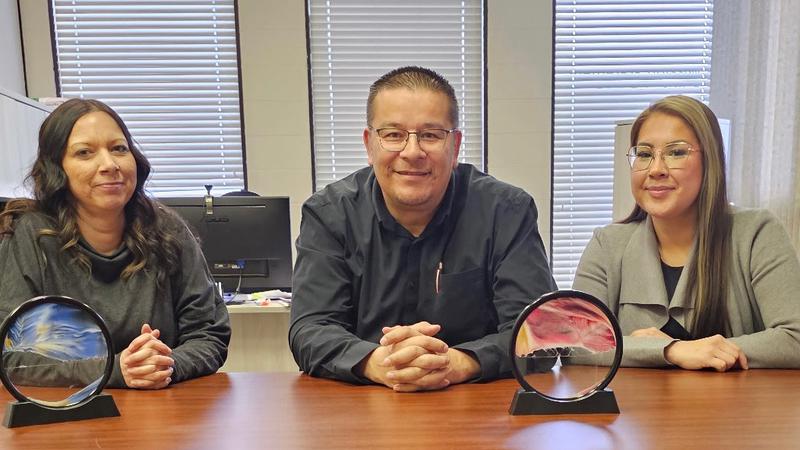
From left, Stacey Francis, court worker; Jason Agecoutay, justice co-ordinator; and Kelsey Fox, community justice worker, pose for a photo at the Battlefords Tribal Council Justice Program office in North Battleford. Penny Mackrell, alternative measures worker, is not shown. (submitted)
BEYOND THE COURTROOM

BTC justice program expands to curb crime, support reintegration in the Battlefords

Jan 23, 2026 | 2:46 PM

The Battlefords Tribal Council (BTC) Justice Program is expanding services in 2026 after receiving federal funding, restoring several community-based supports that had previously been on standby, officials say.

Jason Agecoutay, the program’s justice coordinator, said while some BTC justice services have operated for decades, others are now being restarted to provide broader support in the Battlefords area and surrounding First Nations.

“Alternative measures and court worker programs have been running for years, for the last 30 plus years, but the post sentencing and the civil and family mitigation, the community justice by way of workshops and communities — that was on standby until recently, and where we’re restarting those programs,” Agecoutay said.

Agecoutay explained the expanded services are aimed in part at addressing ongoing concerns about crime in the region by supporting individuals before and after they enter the justice system.

“We wanted to work with the individuals to lessen the crime happening, to educate people and support them through the process that they’re going through,” he said.

He pointed to housing insecurity as one example of how unmet needs can drive criminal behaviour.

“If someone has no home to live in, and they’re creating a crime just to get into being incarcerated due to minus 48 weather, then we want to try to provide them a place to live and work with them, and trying to get them into housing,” he noted.

He said the program also focuses on people leaving custody and re-entering the community.

“So if somebody’s incarcerated and are coming out of being incarcerated, then they would work with our post-sentencing worker,” he said, noting that the program supports people leaving custody by helping them secure housing, identification and employment as they reintegrate into the community.

The program also offers alternative measures and court worker services. Court worker Stacy Francis said the program helps individuals navigate the legal system.

“With the court worker program, we help people through the court system, and we help them to understand their charges, their rights and their responsibilities,” Francis said.

Community Justice Worker Kelsey Fox said her role focuses on outreach, prevention and education within First Nations communities.

“I go out into communities or nations, and I can help with workshops for whatever they might need — violence workshops, domestic violence, gangs, drugs,” Fox said.

She said she is also working to establish community justice committees involving elders and youth.

“I’d like to go out and sit with an elder and a youth in the community and work on how to make it safer for the communities,” Fox said.

Agecoutay said the program is also responding to misinformation affecting youth, particularly content circulating on social media about U.S. law enforcement practices.

“The kids around the area communities are thinking that RCMP can do that as well when they’re misinformed by what’s happening in the U.S.,” he said.

One of the recent incidents that concerns the youth the most is a shooting in Minneapolis, Minnesota, in which a U.S. Immigration and Customs Enforcement (I.C.E.) agent shot and killed a 37-year-old mother of three during an operation in the city, an event that has drawn widespread attention and protest nationally.

He said BTC Justice is working with RCMP on workshops to clarify the differences between Canadian and U.S. law.

“Trust in the RCMP, trust in the justice system, that we’re working together for the benefit of the individual,” Agecoutay said, adding he hopes to launch the initiative by the end of February.

While no statistics are yet available, Agecoutay said the program intends to track outcomes as services expand.

“Once we do get the statistics, I want to be able to reduce it by 50 per cent or more by the end of the year to crimes being done hitting the court systems,” he said.

Agecoutay said the program is open to anyone seeking support and aims to collaborate with communities, organizations, First Nations leadership and local governments.

“We want to build a safer, healthier community of understanding and meaningful support and work together,” he said.

Anyone seeking help or more information about the program can contact BTC Justice at 306-445-1383 or visit its office at 1201 102nd Street in North Battleford.

Kenneth.Cheung@pattisonmedia.com