Click here to sign up for our free daily newsletter
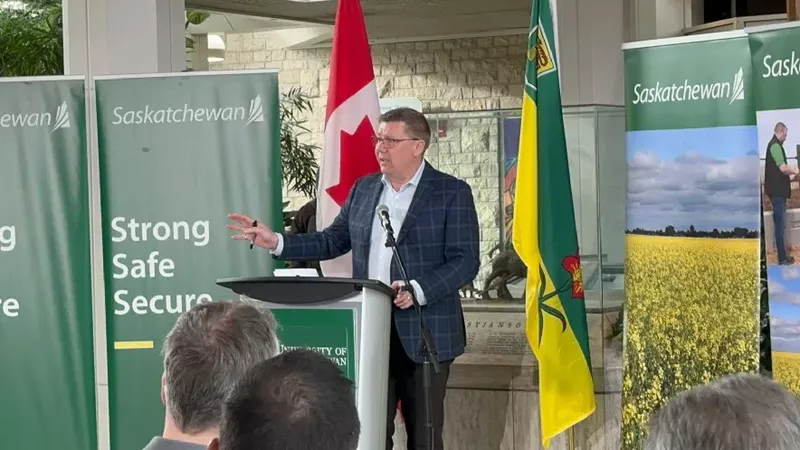
"What this is going to allow us to do is to get back to flowing our canola and pulse stocks to China, as well as many other countries around the world,” Saskatchewan Premier Scott Moe said during a speech at the University of Saskatchewan on Tuesday. (Libby Gray/650 CKOM)
trade negotiations

Scott Moe and Saskatchewan agriculture groups celebrate tariff deal with China

Jan 20, 2026 | 3:02 PM

Saskatchewan’s premier was joined by representatives from a number of agriculture groups at the University of Saskatchewan on Tuesday as he celebrated the tariff deal struck between Canada and China.

The agreement, which was announced on Friday during a trip to China that included both Prime Minister Mark Carney and Moe, will allow 49,000 Chinese-made electric vehicles into the Canadian market at a 6.1 per cent tariff rate. In exchange, China is expected to drop its duties on canola seed to 15 per cent by March, while dropping its tariffs on canola meal, lobsters, crabs and peas. Canola oil was not mentioned in the deal.

Moe said the agreement is “really positive for the Saskatchewan agriculture industry,” which produces about 55 per cent of the country’s canola crop and the majority of pulses as well.

“It’s very, very significant to our Saskatchewan farmers, to all of our exporters, to the processing industry here in our province, but it’s also important to the Canadian agriculture industry, and I would say equally important to the Canadian economy,” Moe said.

“Canola alone employs over 200,000 people across Canada and is a $44 billion industry.”

Moe, who butted heads with Carney’s predecessor Justin Trudeau on numerous occasions, was quick to laud the federal government for securing the deal.

“Credit to the federal government – and you haven’t heard me saying that a lot in the last decade, but I will say it here today – and a credit to Prime Minister Carney for engaging, and engaging earnestly with all levels of the Chinese government, and it certainly has paid off for our ag industry and our Canadian economy,” Moe said.

But while the premier celebrated the agreement, he noted that there is still more work to be done.

“From an agricultural perspective, this gets us back to where we were a year ago. No more, no less, really. We had slight tariffs on some of our ag products a year ago, we have slight tariffs on some of our ag products here today. What this is going to allow us to do is to get back to flowing our canola and pulse stocks to China, as well as many other countries around the world,” Moe explained.

The premier said some have argued that Canada’s economy is overly dependent on both China and the United States, and he doesn’t necessarily disagree.

“That may be true, however they are the largest markets in the world, and in the case of China, it’s a premium market,” Moe said.

“Certainly, we are in the Chinese marketplace for a reason. It’s one of the largest markets in the world and they pay more.”

Moe noted that the deal will be a bellwether for additional trade agreements in the Asian marketplace, and noted that energy presents a great opportunity for Saskatchewan’s exports in the future.

But while Ontario Premier Doug Ford has argued that the agreement with China will harm the Canadian automotive sector, which is largely based in eastern Canada, Moe noted that the relatively small number of Chinese vehicles included in the deal is dwarfed by the country’s agricultural industry.

“That represents about three per cent of the market share for EV cars in Canada, and certainly, I think, when you trade that off with a $44 billion canola industry, plus the pulse industry, plus the beef announcements that were made today, plus the opportunities that we have in energy trade into the future, as well as a wood MOU that was signed on forestry products as well, most certainly this is a beneficial deal and, I would say, a beneficial opportunity for Canada as we look to future trade,” Moe noted.

Another aspect of the agreement which Moe praised was the restoration of dispute mechanisms when it comes to trade between Canada and China.

“Now, when Canadian businesses have a trade challenge, have a product that isn’t available or is having some troubles in the regulatory space in China, all of those dispute mechanisms are back in place,” the premier noted.

“Saskatchewan Pulse Growers is very pleased with the recent announcement of the elimination of tariffs on Canadian peas to China,” Stuart Lawrence, the organization’s board chair, said in a statement.

“It is reassuring to see a high level of cooperation between federal and provincial governments and industry to achieve important results for farmers. In particular, we appreciate the leadership of Premier Moe and the Government of Saskatchewan in an essential role to restore access to our largest market.”

Bill Prybylski, president of the Agricultural Producers Association of Saskatchewan, called the deal “a very positive step” towards improved market stability for the province’s farmers and the industry as a whole.

“While there is more work to be done, this renewed connection sets a strong foundation for future growth and certainty in our agricultural sector,” Prybylski noted.

Bill Huber, president of the Saskatchewan Association of Rural Municipalities, said producers have been waiting months for progress on the tariff situation.

“We are greatly encouraged by the efforts of Premier Moe, Prime Minister Carney, and other federal ministers who travelled to Beijing to meet in person with Chinese officials. SARM looks forward to building on this progress through future trade agreements with China that include beef, pork, and other key commodities,” Huber said in a statement.

– with files from the Canadian Press