Click here to sign up for our free daily newsletter
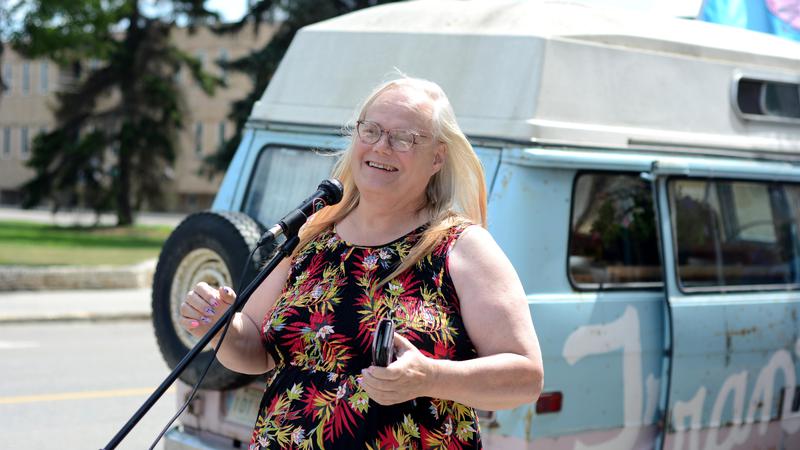
Bobbi Sue Thompson, president of Battlefords Area Pride, is pictured July 26 during the group’s 10th annual Pride parade in North Battleford. (file photo/battlefordsNOW)
BILL 137

Local pride group ‘cautiously hopeful’ Supreme Court will strike down Sask. pronoun law

Nov 6, 2025 | 1:00 PM

The president of Battlefords Area Pride says she’s “cautiously hopeful” the Supreme Court of Canada will overturn Saskatchewan’s school pronoun law — and limit how far governments can go using the Constitution’s notwithstanding clause.

“I’m hoping that they strike down the law and the use of the notwithstanding clause,” said Bobbi Sue Thompson.

“The use of the notwithstanding clause should be restricted to where it’s absolutely necessary, not a matter of political convenience.”

The Supreme Court announced Thursday it will hear appeals in the case involving Saskatchewan’s Parental Inclusion and Consent Policy, which requires students under 16 to get parental permission before changing their names or pronouns at school.

Premier Scott Moe’s government first introduced the policy in 2023, saying parents should be involved in their children’s school decisions.

UR Pride challenged the policy in court, arguing it violated Charter rights and harmed gender-diverse youth.

A judge granted an injunction to pause the policy, but within weeks the province turned it into law and invoked the notwithstanding clause — allowing it to override certain Charter rights for five years.

The province argued the court challenge should be dismissed because the clause had been invoked. But earlier this year, Saskatchewan’s Court of Appeal ruled the case could still proceed. The court said it can’t strike down the legislation outright but can issue a declaratory judgment on whether the law violates constitutional rights.

The appeal court also ruled UR Pride could continue to argue the law breaches Section 12 of the Charter — the right to be free from cruel and unusual treatment — because that section was not covered by the province’s use of the clause.

Both the province and UR Pride have appealed and asked the Supreme Court to fast-track the case so it can be heard alongside a similar challenge in Quebec, where the government also invoked the clause to protect a law banning public-sector workers from wearing religious symbols.

Thompson says Saskatchewan’s decision to rely on the clause has set a worrying precedent, pointing to recent developments in Alberta.

Alberta’s government passed Bill 2: The Back to School Act on Oct. 27, 2025, legislating teachers back to work on Oct. 29 by invoking the notwithstanding clause to end the Alberta Teachers’ Association strike, which began Oct. 6.

“It was unconstitutional,” she said.

“Now they’re looking at putting even more draconian measures against the transgender community in Alberta … for political purposes, not scientific.”

In September, Alberta Premier Danielle Smith has directed officials to invoke the Charter’s notwithstanding clause in amending three laws that affect transgender people, according to a leaked government memo obtained by The Canadian Press.

The three laws, introduced last year, establish rules for students changing their names or pronouns in school, ban transgender girls from participating in amateur female sports, and limit gender-affirming health care.

Thompson says that trend should concern everyone.

“If they can do it to one group, they can do it to anybody,” she said.

For queer and trans youth, she says the political debate has made schools feel less safe.

-With files from The Canadian Press-

cjnbnews@pattisonmedia.com