Click here to sign up for our free daily newsletter
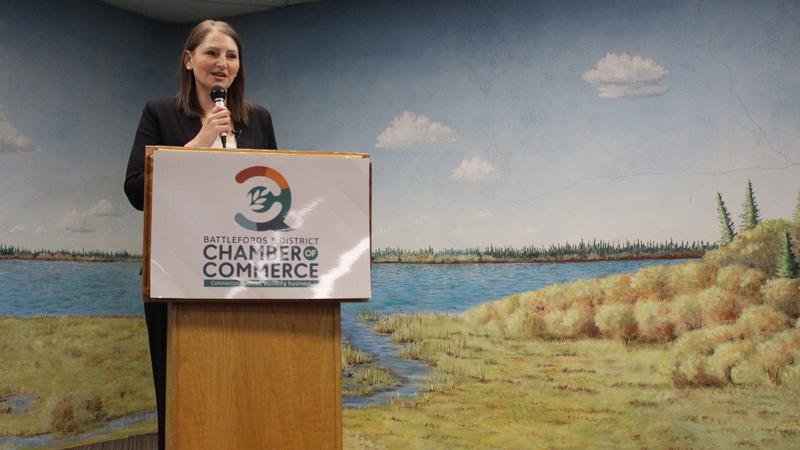
MP Rosemarie Falk speaks to an audience on politics and tariffs. (Julia Lovett-Squires/battlefordsNOW Staff)
Falk visit

Falk talks tariffs, politics at Chamber luncheon

Mar 5, 2025 | 6:00 AM

Hope, resiliency, and a plan forward were the key topics of Battleford-Lloydminster MP Rosemarie Falk’s public meeting at the Battlefords and District Chamber of Commerce on Tuesday.

“Local businesses are the backbone of our economy, creating jobs and providing essential services that people rely on every single day,” she said. “As local business leaders, you are all in tune with the pulse of the community.”

Falk said it now more than ever it was important to build a resilient economy was crucial amid the tariffs imposed by US President Donald Trump, which have now taken effect.

“The impact of these challenges is far reaching, both for individuals and for our country as a whole,” said Falk.

“It is important to recognize that these challenges did not emerge overnight and they certainly did not start on Jan. 20.”

Falk lay the blame at Liberal’s feet, challenging that the federal government needs a Canada First approach. She was critical of a currently prorogued Parliament in the wake of Prime Minister Justin Trudeau’s resignation.

That decision, she said, effectively halted meaningful action against the Trump tariffs.

“While President Trump placed a 28-day pause on the tariffs, Parliament could have reconvened allowing for immediate action to be taken,” she said.

“Instead, the Liberals continued to focus on their own priorities, fighting amongst themselves and trying to preserve their own jobs.”

Under Pierre Poilievre, the government would by contrast present the Canada First Plan, Falk said.

Calling for dollar for dollar retaliation carefully targeting goods may be produced in country or elsewhere. She explained that their plan would ensure that 100 per cent of proceeds from counter tariffs would go directly to reimbursing businesses and workers who were impacted.

“Any remaining funds would go towards tax cuts for Canadians and not more government spending,” Falk said.

Further speaking to what she called a common-sense Conservative plan that would also involve working with premiers and increasing interprovincial trade and strengthening the border, the audience had a chance to ask questions.

North Battleford Mayor Kelli Hawtin asked about municipal infrastructure funding.

“(Investing in Canada Infrastructure Program) ICIP funding was a major player in large infrastructure projects for municipalities,” she said, noting she hasn’t heard any party talk about that type of infrastructure.

“A significant project we’re facing here in North Battleford is replacement of our 1960s arena that is looking so far like approximately a $60 million project. Municipalities our size can’t do major infrastructure without help from other levels of government,” Hawtin added, noting it is usually related to growth.

Falk said she didn’t have any surprises, and she would continue to be an advocate for the communities – especially in the rural areas.

“Something that the Trudeau Liberals again, coalesced with the NDP have done very exceptionally well is pit rural versus urban,” she said.

“I tell a lot of my municipalities, ‘If I don’t hear about an issue that you’re having or if you’re needing funding for something I can’t go and advocate for it.’”

City Manager Randy Patrick asked about Canada’s inefficient ports.

“What are you going to do because that’s what we have to put the product through and it’s a real mess,” he asked.

After asking for clarity on the question, Falk said they could say the same for airlines.

“We know that Canada – I mean (Toronto Pearson International Airport) is rated if not the worst, one of the worst airports in Canada,” she said.

“We have to have a real look at bureaucracies, what is causing this and iron that out because that’s the other thing – I hear this from farmers all the time and farm advocacy groups.”

Falk said the farmers often face situations where they have made their contract, they send to the ports and then issues happen.

“We have to look at the inefficiencies so, that we can make sure that small business owner, that farmer can get his product – and fulfil his side of the contract,” she said.

“Looking at the red tape, looking at the policies and making sure that we’re more efficient and productive so, that other countries still want to deal with us.”

julia.lovettsquires@pattisonmedia.com

On BlueSky: juleslovett.bsky.social