Click here to sign up for our free daily newsletter
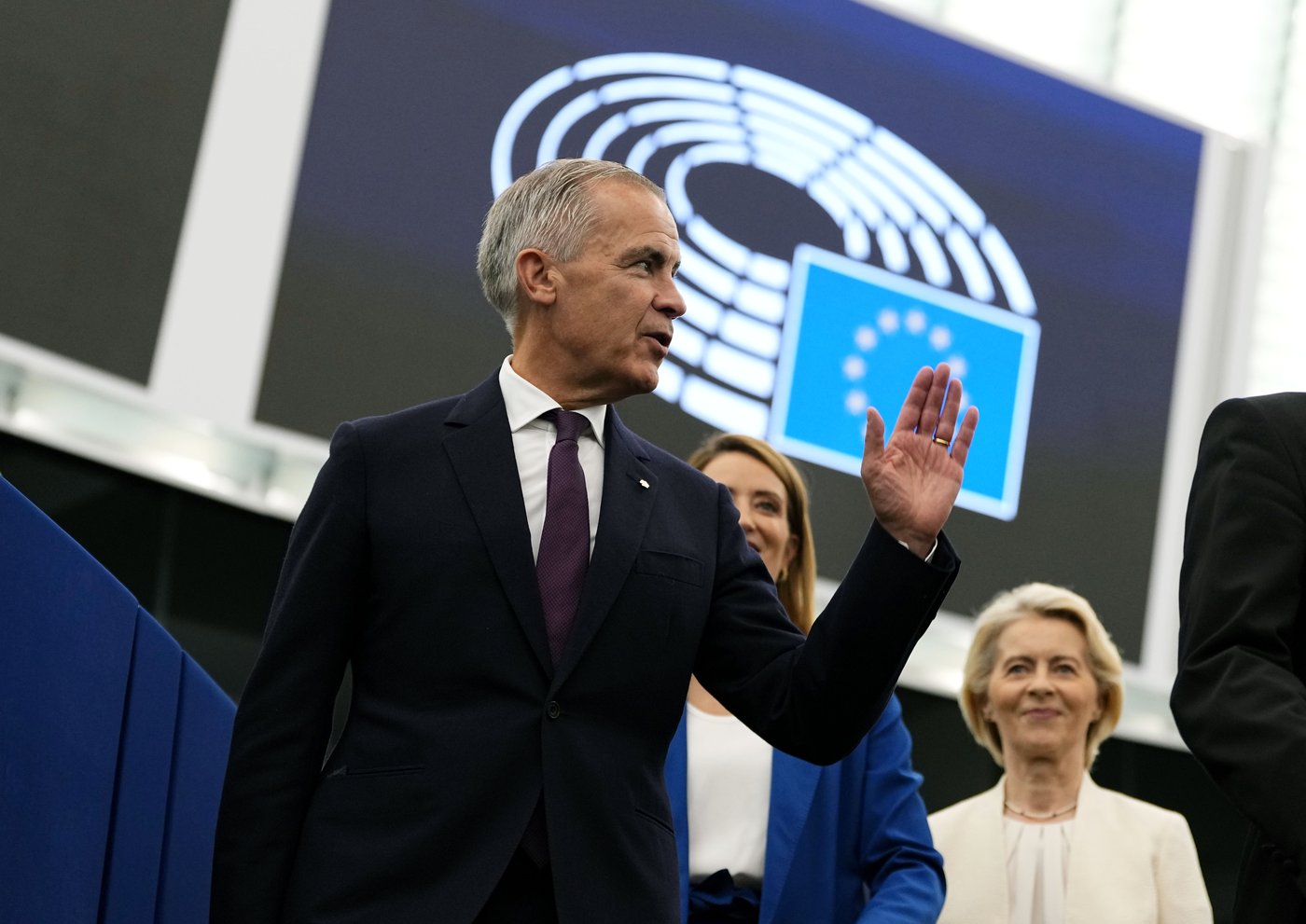
Prime Minister Mark Carney waves as he arrives in the Hemicycle of the European Parliament in Strasbourg, France, to attend the State of the European Union address by European Commission President Ursula von der Leyen, back right, on Wednesday, Sept. 16, 2026. THE CANADIAN PRESS/Justin Tang

Von der Leyen’s pitch for EU security council involves Canada, but it’s not clear how

Sep 18, 2026 | 2:00 AM

OTTAWA — A proposed new European security forum would include Canada, Britain and Ukraine as partners — but defence experts here say it’s not clear what the council, or Ottawa’s involvement, ultimately would look like.

European Commission President Ursula von der Leyen laid out a sales pitch for a new European Security Council in a speech to the European Parliament in Strasbourg, France, on Wednesday.

“For a long time, we have discussed a leaders’ format focused on the security of our continent, with partners like Canada, Norway, Ukraine, the United Kingdom and others involved,” she said.

“This is even more urgent now, given the nature and scale of the risks at play. This is why we will set out our ideas to make a European Security Council a reality.”

Prime Minister Mark Carney, who had a front-row seat for the speech, has been seeking alternate ways for Ottawa to manage security and trade that don’t involve the United States.

Stephen Saideman, a professor at Carleton University’s Norman Paterson School of International Affairs, said it’s not clear if such a council would be largely symbolic or focused on co-ordinating policy.

But it appears to be a “perfectly reasonable way” to manage dealing with the United States under the chaotic and unpredictable administration of President Donald Trump, he said.

“The Europeans are starting to think about Canada as being in this world without a reliable United States. That by itself is important. Even if this is just a symbolic thing, the symbolism is still important,” he said.

Saideman said it also could be a way to develop “legal structures and political co-ordination to figure out how to respond to these creative ways in which (Russian President Vladimir) Putin and others are trying to annoy and harm us and divide us.”

Von der Leyen said Europe needs a new mechanism to “flank” NATO’s collective defence provisions to counter emerging hybrid threats that fall below the legal threshold of armed military attacks.

The EU’s top bureaucrat pointed to a few recent examples, including a drone attack on an airport in Leipzig last month. The Germans have blamed Russia for that attack.

Russia has been testing Europe for a few years now through actions like cutting undersea cables and sending drones across borders — incidents that don’t qualify as traditional attacks.

The idea for the new security body also comes as many in Europe question whether Trump would come to the continent’s aid in a security crisis.

The Pentagon ordered a troop drawdown from Germany earlier this year and reportedly wants European states to take over most of NATO’s conventional continental defence by 2027.

Kerry Buck, Canada’s former ambassador to NATO, said that in the absence of public details of the proposal, it’s not clear how such a council would work in practice.

The European Union already has a mutual defence clause which says that if a member state is attacked, the other members must come to its aid, consistent with their commitments under NATO.

But there’s a clear division in how Europe’s collective defence is organized. NATO has a command structure that organizes kinetic military responses and deterrence, while the EU mostly takes care of things like aligning procurement initiatives.

Buck gave the example of tank purchases — instead of allied militaries buying 21 different makes, the union would help them co-ordinate on acquiring a smaller number of interoperable tanks.

She said there could be space for a security council if it focuses not on military response but on issues that fall under the threshold of an armed attack — things such as cyber attacks or disinformation aimed at polarizing electorates.

“It could be a useful contribution to security architecture in Europe if that’s what the EU Security Council focuses on,” Buck said.

“If it’s about duplicating NATO and situating that inside the EU architecture, from my perspective, without knowing the details, that seems to me to be less credible and a less useful contribution.”

The French newspaper Le Monde quoted EU Defence Commissioner Andrius Kubilius saying that “key details of new defence architecture” would be sketched out in a forthcoming security strategy document.

Kubilius published a paper earlier this year suggesting that such a council could work like the UN Security Council, with a core group of permanent members, such as Germany, France and Poland, and other members rotating in and out.

The idea is not a new one. It’s been kicked around for decades in various forms.

French President Emmanuel Macron and then-German Chancellor Angela Merkel put a continental security council on the political agenda nearly ten years ago, with an eye to maintaining security relations with the United Kingdom after Brexit.

But the idea remained vaguely defined and never gained any traction.

Luigi Scazzieri, a senior policy analyst at the European Union Institute for Security Studies, noted in an article published in February that the core appeal of the idea is that it could lead to faster decision-making and better coordination.

But debate over the proposal, he wrote, has “long been shaped by a lack of clarity over what such a body would actually look like” and could run up against “political and practical constraints” from member states, depending on the proposed design.

This report by The Canadian Press was first published Sept. 18, 2026.

Kyle Duggan, The Canadian Press