Click here to sign up for our free daily newsletter
Saskatchewan's overall CSI was 146.64, nearly double the Canadian figure. (Image Credit: ID 109503673 © Andrew Sentipal | Dreamstime.com)
Crime severity

Northern Saskatchewan communities among Canada’s highest for crime severity

Jul 22, 2026 | 11:34 AM

Several northern Saskatchewan communities continue to record crime severity levels far above both the provincial and national averages, according to newly released 2025 data from Statistics Canada.

The Crime Severity Index (CSI), which measures both the volume and seriousness of police-reported crime, was 75.01 nationally in 2025. Saskatchewan’s overall CSI was 146.64, nearly double the Canadian figure.

But in several northern communities, the numbers were substantially higher.
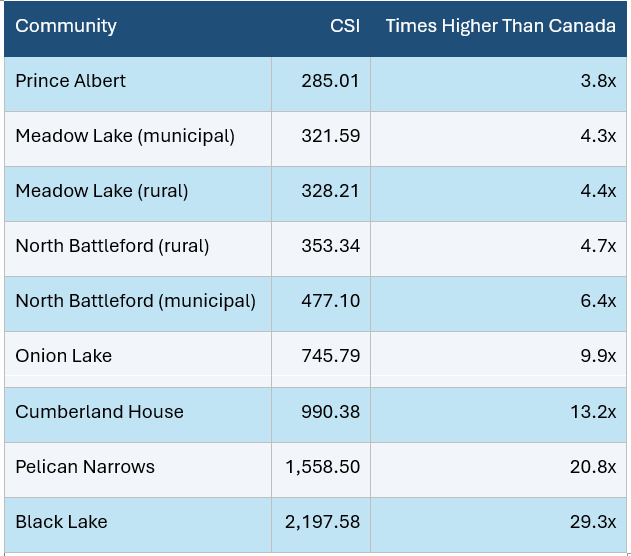

The numbers do not mean those communities experience 10, 20 or 30 times more crime than the rest of Canada.

Instead, the CSI measures crime relative to population and assigns greater weight to more serious offences. That means smaller communities can record very high CSI scores when serious crimes make up a larger proportion of police-reported incidents.

Statistics Canada uses the index to compare communities across the country by accounting for both crime volume and severity, rather than relying solely on the number of reported offences.

Several larger centres in north-central Saskatchewan also recorded CSI scores well above both the Canadian and provincial averages.

Prince Albert reported a CSI of 285.01, nearly four times the Canadian average.

La Ronge recorded a CSI of 707.81, more than nine times the national average and nearly five times Saskatchewan’s overall CSI. The community also reported a violent CSI of 1,011.32, indicating violent offences continue to be a major contributor to crime severity in the region.

Meadow Lake’s municipal detachment area recorded a CSI of 321.59, while the surrounding rural detachment area was slightly higher at 328.21.

In the Battlefords region, the North Battleford municipal detachment area posted a CSI of 477.10, more than six times the national average. The surrounding rural detachment area recorded a CSI of 353.34.

Melfort stood out as an exception among the communities examined. The city’s municipal RCMP detachment area recorded a CSI of 127.80, while the surrounding rural detachment area reported 128.63. Both figures were below Saskatchewan’s CSI of 146.64, though still above the Canadian average of 75.01.

Violent crime continues to be a significant contributor to many of the higher scores.

Prince Albert recorded a violent CSI of 507.19, while North Battleford’s municipal detachment area reported a violent CSI of 539.50.

The highest violent CSI among the communities examined was Pelican Narrows at 2,300.25. Black Lake recorded a violent CSI of 1,639.69 and Cumberland House reported 896.98.

The Saskatchewan RCMP said the newly released statistics reinforce the need for continued efforts to address crime in communities across the province.

According to the RCMP, 60 of Saskatchewan’s 84 detachment areas with populations greater than 1,000 recorded CSI scores above the Canadian average. Of those, 11 reported CSI scores more than 10 times higher than the national figure, and 25 of those communities are located in northern Saskatchewan.

The force said it is continuing to modernize policing through initiatives including rotational drive-in policing models, intelligence-led policing and targeted enforcement operations.

One such rotational model is currently being tested in Pelican Narrows where a fatal shooting recently took place. The RCMP says the approach helps ensure adequate staffing levels, increases officer availability and provides additional support for frontline members responding to calls for service.

The force is also investing in additional analysts to identify emerging crime trends and direct resources where they are needed most. Specialized units, including Crime Reduction Teams and Warrant Enforcement Response Teams, continue to target prolific offenders, organized crime networks, illicit drugs and firearms offences.

Between April 1, 2025 and July 15, 2026, Saskatchewan RCMP’s Saskatchewan Enforcement Response Team conducted 410 deployments across the province, including 164 in northern communities.

“As Saskatchewan’s provincial police service, we have an obligation to make every effort to enhance our service delivery to combat crimes and continue to evolve with the changing policing environment,” Superintendent Amber Clark said in a statement.

“That’s why we’re not standing still. We’re modernizing how we police, investing in intelligence-led approaches, and strengthening partnerships to target prolific offenders, disrupt drug networks and continue focusing on our core mandate: community safety.”

The complete Crime Severity Index data for police jurisdictions across Saskatchewan was released Tuesday by Statistics Canada and the Canadian Centre for Justice and Community Safety Statistics.

panews@pattisonmedia.com