
Click here to sign up for our free daily newsletter
(Image Credit: ID 81003321 © Sarayuth Punnasuriyaporn | Dreamstime.com)
You could be the next victim

Fraud Prevention Month: How to protect yourself as scams grow in Saskatchewan

Mar 2, 2026 | 4:13 PM

Fraud is climbing across Saskatchewan and more victims are losing thousands of dollars as financial institutions warn residents to stay vigilant during Fraud Prevention Month across the country.

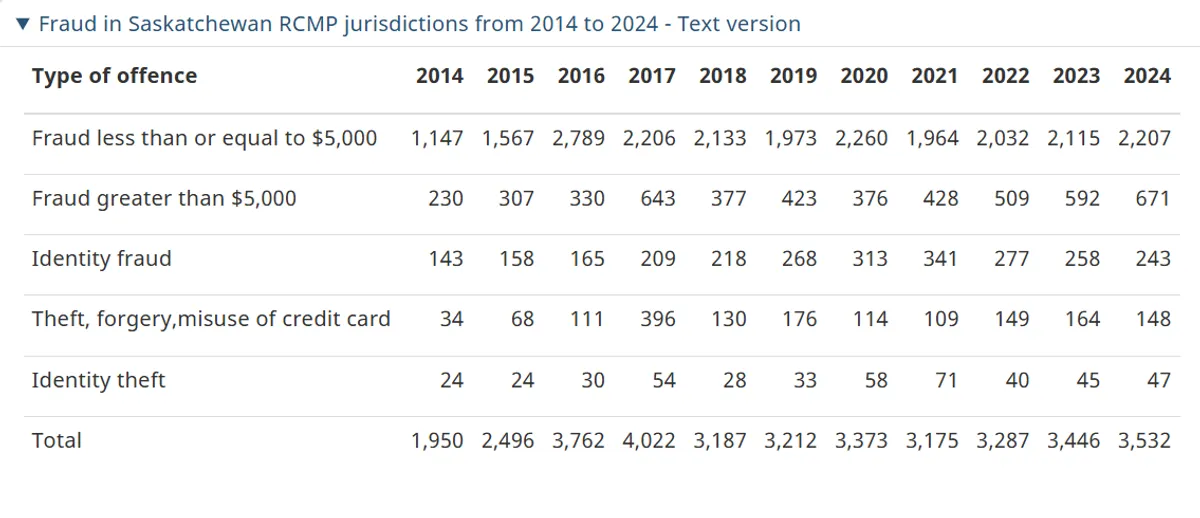
Recent data from Saskatchewan RCMP shows fraud reports in the province rose 81 per cent between 2014 and 2024, from 1,950 to 3,532, with cases involving losses greater than $5,000 increasing sharply over the same period – rising by 192 per cent.

Reports involving theft, forgery and misuse of credit cards have surged even more dramatically, increasing by 335 per cent over the decade and underscoring a growing financial threat facing residents.

The figures highlight a long-term upward trend in fraud across the province and a shift toward higher-value scams that can leave victims with significant financial losses.

“The internet gives everyone instant access to information – including fraudsters who use it for financial gain,” said Sgt. Lorna Dornstauder of the Saskatoon Provincial General Investigation Section.

“Our analysts examine fraud-related crime data to identify trends and patterns.”

While smaller scams under $5,000 continue to make up the majority of reported incidents each year, RCMP say higher-value fraud has seen one of the steepest increases, reflecting the growing sophistication of modern scams.

March marks Fraud Prevention Month across Canada, and Saskatchewan’s largest financial cooperative, Conexus Credit Union, is urging residents and its more than 200,000 members to stay alert year-round as fraud attempts continue to rise.

“We’re encouraging people to really make themselves aware and use available resources,” said Mark Millham, chief risk and compliance officer at Conexus Credit Union.

Recent estimates suggest daily scam attempts in Canada number in the billions, according to the national Stand Against Scams campaign, highlighting the scale of the issue facing financial institutions and consumers.

Millham said scammers often rely on reaching as many people as possible, knowing only a small number need to respond for a scheme to succeed.

“Scammers rely on volume,” he said.

“So they will reach out to thousands of people, hundreds of thousands of people, and all they really need is one person who happened to be maybe doing some sort of transaction or something in their life, sort of triggered, aligned with what the fraudsters are reaching out to, and people quickly become trusting and can fall victim to it.”


(Image Credit: Saskatchewan RCMP)

To help people protect themselves, Conexus is promoting what it calls the “three R’s” of fraud prevention: recognizing, rejecting and reporting suspicious activity.

Millham said one of the most important rules is to never share personal security codes or passwords with anyone.

“Think about it like your PIN number for your debit card. You would never share that with anybody, and no one should ever ask you for it.”

Conexus, Cornerstone and Synergy credit unions do not request login credentials or one-time passwords from members, and customers are urged to hang up immediately if anyone asks for that information.

Members are advised to only enter banking credentials through official digital banking platforms, download their credit union’s app or bookmark the official website, and avoid clicking links sent to them.

Financial institutions are also urging caution during periods of change or uncertainty, when scammers may impersonate trusted organizations.

“Fraudsters like to take advantage of the uncertainty,” Millham said.

The warning comes as Conexus, Cornerstone and Synergy credit unions have recently amalgamated, a transition that Millham said could be exploited by scammers posing as legitimate representatives.

Long-term scams, including those involving romance or investment opportunities, are also a growing concern. These schemes often involve building trust with victims over time before convincing them to transfer money or invest in fraudulent opportunities.

“One red flag we’d like to share for everyone is to really watch out if you or someone you know is ever being coached to lie to your financial institution about what money is being taken out for,” he said, adding that such a request should be reported right away to both the financial institution and police.

“We’d never mind taking a look at things, even if it’s not accurate or if it’s not a fraud, we really would rather do that for you,” Millham said.

RCMP say education and awareness remain the most effective tools in preventing fraud and limiting financial losses.

“Fraud can happen to anyone and anywhere,” said Const. Kristy Fines. 

“By learning the signs of fraud, sharing that knowledge with your loved ones and reporting incidents, you can help protect others from becoming victims.”

Kenneth.Cheung@pattisonmedia.com