Click here to sign up for our free daily newsletter
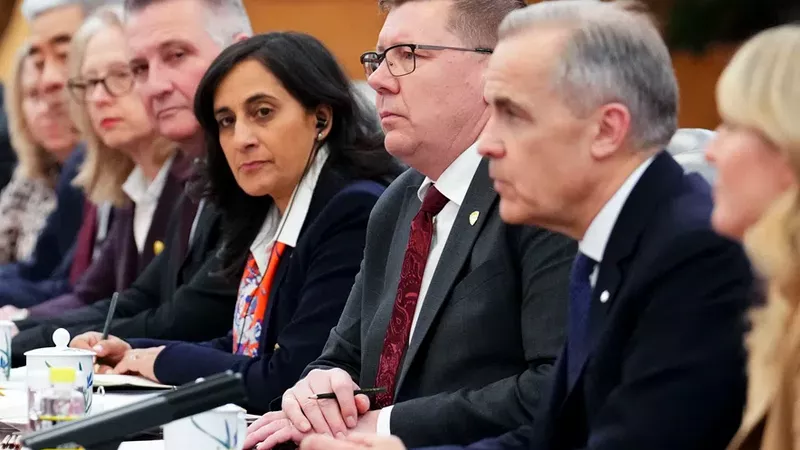
Premier of Saskatchewan Scott Moe, third from right, sits beside Canadian Prime Minister Mark Carney, second from right, as they take part in a bilateral meeting with Premier of China Li Qiang at the Great Hall of the People in Beijing, China on Thursday, Jan. 15, 2026. THE CANADIAN PRESS/Sean Kilpatrick
Sask Reax

Sask. Premier Scott Moe calls tariff deal with China a ‘tremendous, landmark agreement’

Jan 16, 2026 | 10:08 AM

Premier Scott Moe is feeling optimistic after Canada and China struck a deal that will significantly reduce tariffs on canola products, a keystone of Saskatchewan’s economy.

The deal announced on Friday by Prime Minister Mark Carney will see Canada allow up to 49,000 Chinese-made electric vehicles into the Canadian market annually, with a 6.1 per cent tariff applied to their import. In exchange, China is expected to drop duties on canola seed to 15 per cent by March, and drop its tariffs on canola meal, lobsters, crabs and peas from March to at least the end of 2026.

Moe, who accompanied Carney on his trip to China, spoke from overseas with radio show host Evan Bray on Friday morning to share his thoughts on the agreement.

While Moe frequently butted heads with Carney’s predecessor, Justin Trudeau, the Saskatchewan premier was quick to credit Carney for his efforts to reduce the tariffs that have been creating issues and uncertainty in the provincial economy.


The following transcript has been edited for length and clarity.

EVAN BRAY: You headed over to China with this delegation, I’m sure with an idea in your mind of what success would look like. Did we get there?

SCOTT MOE: I think we did. We saw the drastic reduction in canola-seed tariffs. We ship $3 billion of canola to China each and every year, and I think with this we have the opportunity to get back to that volume and even more. And second is the canola meal tariffs are down to zero, and that provides us the opportunity for our crush volumes to start to increase back home in Saskatchewan. And so two really significant markets – our domestic crush and our canola seed to China – are being opened up for this deal. So by every aspect of how you measure success, this particular deal certainly spells out success, I would think, for the ag industry.

We talked on our program about the importance that the federal government recognize the value in having you there as the leader of our province. Can you talk about the role you feel that you and the Saskatchewan government played leading up to and during these discussions to get this deal?

MOE: We’ve been present as a province in this market for close to two decades now. And many of the folks that we engaged with last September, when Parliamentary Secretary to the Prime Minister, Kody Blois came, and let me just say he has been very much a continuous face, and so credit to Blois for providing that effort and that engagement – but many of the folks that are part of the negotiation from China’s side are folks that we had engaged with at some point over the last number of years. Case in point, Minister Wang (Wentao) is the minister of finance and commerce here. I had an engagement with him back in 2019 when he was governor of Heilongjiang. And so you start to form these relationships that are important in this market and many others. And I think that has maybe helped advance some of those discussions. However, it takes two to have the discussion. And I very quickly say – and I wouldn’t have said this three years ago – credit to the prime minister. He was in the market. He had six of his ministers here in the market, and I think that was significant in getting this particular trade agreement across the line, which is so impactful to the Saskatchewan and Canadian ag industry. I failed to mention pulses. Pulse tariffs are down to zero as well. Just a tremendous, landmark agreement that I think is going to benefit not only the ag industry, but our general Canadian economy.

When we think about the canola industry, value-add canola crush is becoming a bigger thing in our province, although we saw a project halted because of the uncertainty in the investment environment. Does this deal strike some strength back into the certainty, the viability of this?

MOE: I suspect it’s going to reinvigorate that conversation on our local crush capacity and where we can get to in the short term. The fact that the canola the meal is going to start flowing again, tariff-free into China is very, very significant for our local Saskatchewan and Canadian crush industries. They have a market for that product, and so it is going to, I think, bring back a much more serious discussion on the levels of operation that we see locally in our province. And any projects that may be on pause for a period of time, I would hope that they’ll reconsider, and that’ll be part of the engagement and the conversations that we’ll be having over the next number of days.

The MOUs that we’re struck on energy, is this something you were aware of being on the agenda going over there? And your thoughts on what this means for Canada, and maybe even more specifically, Saskatchewan?

MOE: Yes, this is an opportunity. So there’s really two pieces to this agreement. One is it restores the trade and the tariffs, for all intents and purposes. A very low-tariff or tariff-free environment for our ag products and other Canadian products as well. Two is when you add the MOUs that were signed – in particular the MOUs on energy engagement – it provides, really, a stepping stone, or a basis, or a foundation for us to really start to expand trade, not just in China but in the entire Asian region. This is why the is the MOU with Alberta, the pipeline discussion, expansion of TMX, expansion of the industry, is so very important. This is why the conversations we’re having with nuclear power using Saskatchewan uranium are so very important as well, and so I think there’s opportunities for Saskatchewan to be back in this market in very short order, engaging on, expanding and building on our agricultural trade in the energy space, alongside with other provinces.

In recent years there have been attempts in Canada to limit Chinese investment in our energy sector. Are there any worries about this pipeline that we are wanting to get built from Alberta to the west coast? Now perhaps there’s, there’s an opening for Chinese investment there. Does that worry you at all?

MOE: No, but it needs to be “good fences make good neighbors.” And one of the understandings in the conversations that I had with people that I’ve met on multiple occasions previously from the China side of the negotiation is that we have differences. There’s differences in governance. We have many differences. We need to respect those differences, and we need to move forward where we have points of collaboration. And so good fences make good neighbors, and what I think we saw, whether it be the multiple memorandums of understanding that were signed, or whether it’s the the trade agreement that restores low or tariff-free trade on ag products, canola and pulses, that is the basis of how we move forward, and I think that’s important. I saw in the tone of the discussions that that was recognized, accepted and respected, and that is something that I haven’t seen over the last number of years. And so I’m quite hopeful, and even bullish on the opportunity that lies before us in expanding our exports, our opportunities to engage with China, but also laying out very clearly what the ownership rules might be in various businesses. Land, obviously is not in that space, but there are various businesses where there are percentages of foreign ownership that operate across Canada today, and those rules will be in place as we move forward.

I want to address a video that is circulating on social media. It’s in news media as well, when Prime Minister Mark Carney in a very distinct, slow manner, says this is setting the pace for the “new world order.” You didn’t say anything, but you’re sitting right beside him and your head kind of turns quickly towards the prime minister. What was in your mind at that moment?

MOE: I don’t have my devices with me, so I haven’t I’ve not seen the video. However I was there, as you mentioned, when those words came. I would just say this. I wouldn’t have used that phrase. That phrase can be interpreted – will be interpreted – differently by different people in our province and across Canada. So it certainly isn’t a phrase that I would have used, but when you do look at the relationships, largely the trade relationships, and just look south of the border where we have a president that very blatantly said he’s going to reset trade relationships of Canada and many other nations, things are in flux, and what was certain and at times we took for granted with respect to our country-to-country relationships and how we trade in a tariff-free environment, whether it be through USMCA or its predecessor, NAFTA, that just isn’t on anymore, and it isn’t on with many countries around the world. And so we’re in a very uncertain and ever-changing and quick-changing world today, from a policy perspective and from a trade perspective, and we need to deal with it. And I think the prime minister and a number of ministers in the market in China these last couple of days bringing this agreement to fruition is an example of how we can provide some certainty in a very uncertain world. So I wouldn’t have used that phrase, because there’s a lot of interpretations that can come with that phrase, but nonetheless we’re in an uncertain world, and we’re trying to support those that are trying to provide certainty for as long as they can.

What does this do, and did you have discussions with the prime minister about the reaction we might get from the United States on this newly announced trade deal?

MOE: We’ll see what, if any, reaction that may come from there. But this isn’t shouldn’t be Earth shattering, looking in from the outside. We used to, as a province, do four to five, sometimes five-and-a-half billion dollars of exports to China. What this does is restore that opportunity and and provide an opportunity to build on it in the energy space, for example, with the MOUs that are there and countries, independent countries like Canada, need to be able to strike deals with countries around the world. And that should not and cannot be impacted by third-party countries, even when they’re an important trading partner to us as well. And so we’ll see what the discussion is from the president and his administration, but certainly from Canada and Saskatchewan’s perspective, this is our second-largest trading partner in providing some degree of trade certainty, at least in the agricultural space, but I would say, more broadly, an opportunity to increase trade in other industries as well should not be something that the United States or anyone else criticizes Canadians for; controlling your own destiny in any way that we can. We’ve been advocating for this, and we’re happy to see it.

Lots of people at the Crop Production Show were saying they were very happy and proud to see the Saskatchewan premier in China with the Canadian prime minister on this. I watched some of the news clips on it, and I see you sitting beside the prime minister. I’m not so sure that would have happened a couple of years ago. Can we just get your thoughts on that relationship?

MOE: I’m not surprised myself that it’s happening today. But we have a common goal, and that common goal is to create value, in this case for our ag industry. But our goal is always “Can we have market access and create value for industries that are employing people and allowing us to have to have the jobs that we love in our province?” And that’s where we very much align with the prime minister. And I’ll be very blunt, and again, this is something I wouldn’t say two years ago with the previous fellow, I welcome the credibility that Prime Minister Carney is bringing on behalf of Canadians to the federal sphere and the international trade sphere. We’ve always prioritized that. We’ve always known it’s important and prioritized it on a provincial basis, and we welcome it from the federal government. And so a good result on behalf of our ag producers. And as the Crop Production Show closed out this week, giving our ag producers something to do now, which is hopefully load up some canola and sell it to a country like China, the United States of America or one of our local crush plants.

–with files from The Canadian Press