Click here to sign up for our free daily newsletter
(ID 98037421 © Karen Foley | Dreamstime.com)
Overdose deaths

Fatal drug overdoses reached five-year low in 2025

Dec 31, 2025 | 9:52 AM

The number of people in Saskatchewan dying of drug overdoses continued to drop in 2025, according to data from the provincial Coroner’s Service.

While numbers are not yet finalized, as of the beginning of December, there were 304 suspected and confirmed cases of overdose, compared to 345 in 2024.

The most common source of overdose was parafluorofentanyl, a synthetic opioid, which killed 74 people, while methylfentanyl killed another 40. Both drugs are also called China White.

Carfentanyl killed 46 people and 44 people died after ingesting fentanyl.

Last year, the Coroner’s Service also began tracking the presence of benzodiazepines in overdose deaths and found them in 123 cases.

Benzodiazepines are sedatives that treat disorders such as panic, anxiety, insomnia and seizures when prescribed. When used illegally, dealers add them as cutting agents to other drugs or to enhance the impact of other opioids.

Naloxone, the most common treatment for opioid overdose, does not work on benzodiazepines.

The coroner’s office also tracks overdose deaths by age, gender and race when it comes to confirmed cases.

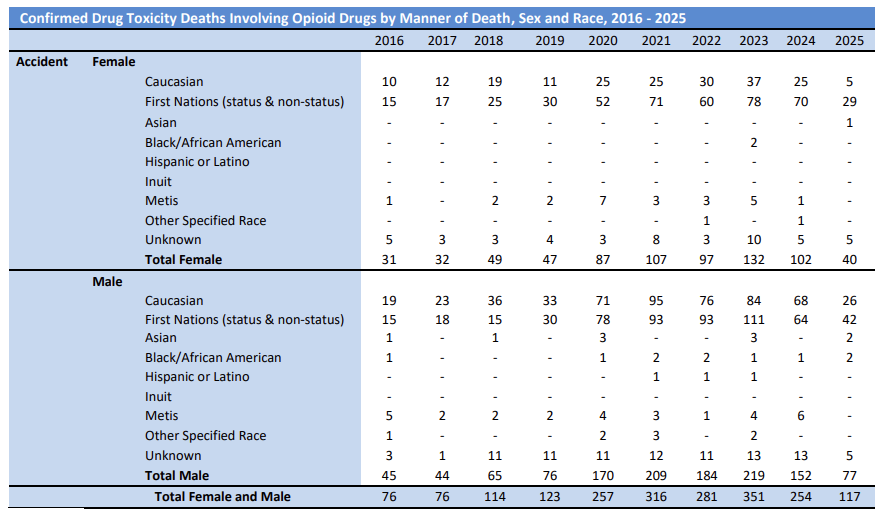
In 2024, five Caucasian women/girls died of overdose, a significant divergence from the 29 First Nation’s women and girls. One woman of Asian descent died and five other women or girls of unknown ancestry.

Last year, 40 females died of overdose compared to 102 in 2024 and 132 in 2023, a peak year for fatal overdoses in the province.

Overdose numbers over time. (Sask. Coroner’s Service)

When it comes men and boys, the numbers go up dramatically, which the coroner’s office said is fairly common.

This year, 26 Caucasians died, 42 First Nation’s men or boys, two Asian males and two Black men/boys. Five had no known ancestry.

That makes a total 77 men or boys that died of confirmed overdose, less than one half of last year’s total of 254 and about one third of the 351 that died in 2023.

A notable fluctuation in the numbers shows more Caucasian men/boys died last year than their Indigenous counterparts. Proportions vary year to year.

As far as age of death goes, the decade most likely to die are people in their 30s in both genders.

People in their 20s and 40s are second and third most likely to have a fatal overdose with numbers dropping in both age directions after that.

When it comes to location, Saskatoon had the highest number of confirmed overdoses this year at 74. That was followed by Regina with 42 and Prince Albert with 11.

READ MORE: Prince Albert overdoses per capita double the provincial average

Smaller communities are not spared, however. Rosthern saw one confirmed overdose death, and there were two in Pelican Narrows. One person died in on the Pelican Lake First Nation, another in Onion Lake, two in Nipawin, one in Naicam and one in Melfort.

Two overdose deaths were seen in Lloydminster, three in La Ronge and two on the Lac La Ronge First Nation.

One person overdosed in Green Lake, one person in Codette, two on the Big River First Nation, two on the Beardy’s & Okemasis First Nation, one person in Battleford and four people died on the Ahtahkakoop First Nation.

While opioids are much more likely to cause overdose, they are often mixed with meth and the person who died frequently had both drugs in their system.

In 2025, that number in confirmed overdose cases is 85, in 2024 it was 170 and in 2023, it was 252.

Across Saskatchewan, 11 deaths were solely caused by methamphetamine toxicity.

An opioid created to sedate large animals, Xylazine, was the cause of 56 deaths in Saskatchewan so far in 2025, a big reduction from the 150 people it killed last year.

susan.mcneil@pattisonmedia.com