Click here to sign up for our free daily newsletter
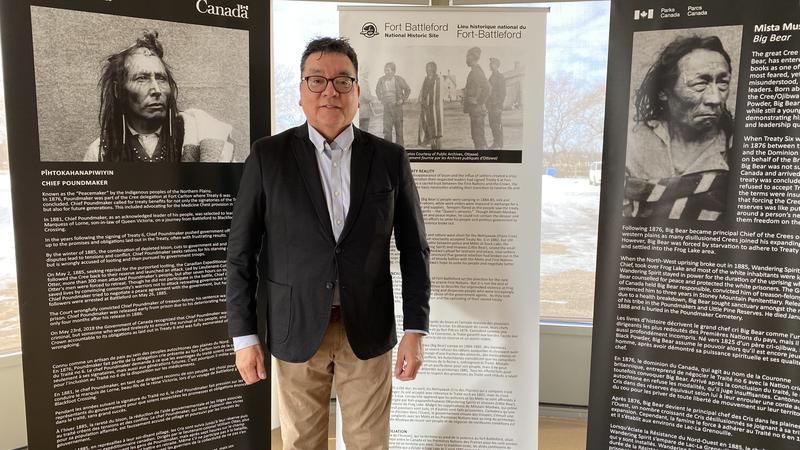
Milton Tootoosis stands by between banners that feature his ancestors Poundmaker and Big Bear. He was at Fort Battleford Friday to host a workshop on economic reconciliation. (Julia Lovett-Squires/battlefordsNOW Staff)
Tootoosis Talk

Milton Tootoosis presents workshop on economic reconciliation at Fort Battleford

Feb 28, 2025 | 4:34 PM

In Cree, the word ‘Pimacihisowin’ is the ability to take care of oneself.

In a presentation earlier Friday at Fort Battleford, Milton Tootoosis presented on the importance of economic reconciliation and to reinforce that sentiment.

“I’m always excited to speak to a community regardless, because I know a very high percentage of the content is probably not in their high school curriculum let alone college,” he said.

As Owner of MGT Consulting, he was invited by Parks Canada to host a workshop on the subject.

“This is an older generation group – probably baby boomers for example who likely didn’t hear a lot of this,” said the facilitator.

“Surprisingly, many of them are attuned, aware of the Indian Residential School experience because of all the media that has generated the last five years.”

Tootoosis explained that he didn’t spend much time on the residential school history but did spend time speaking about the historical aspects that eventually led to inequities that are still being felt hundreds of years later.

“Let’s not kid ourselves, there’s still far too many people unemployed or underemployed. Poverty rates are still too high, there’s so many social challenges,” he said, adding he also spoke about the interpretation of treaty.

“It can be interpreted as a treaty promise to a good livelihood, which has by and large, not materialized.”

By choosing to focus the lecture on economic reconciliation, he said this is how creating economic literacy within the community can be achieved.

“I’m always excited to talk about positive developments that are taking place in Indian Country,” he said.

The presentation was broken up into various segments and Tootoosis highlighted the different businesses and corporations that already exist. Speaking of the 2021 Mi’kmaq Coalition’s acquisition of Clearwater, which came after a longstanding contentious battle between the Indigenous and non-Indigenous fishers in the East Coast and ultimately led to chiefs of seven Mi’kmaq communities throughout Nova Scotia and Newfoundland and Labrador forming the coalition to buy out the non-Mi’kmaq.

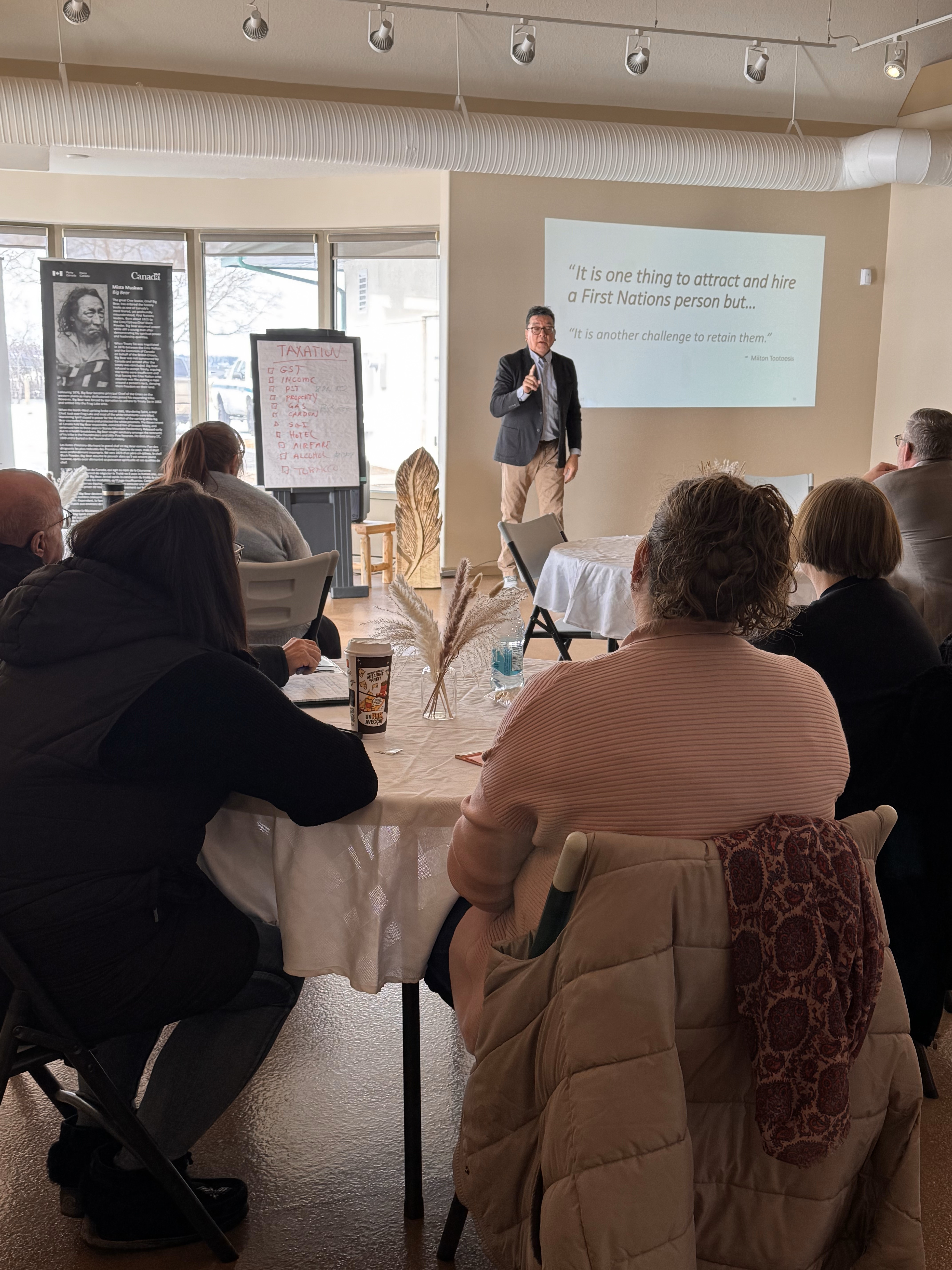
Milton Tootoosis speaks to the group. (Parks Canada Staff Photo)

“So, they own a majority,” he said.

“Now the same company that buys fish and lobster as an example from the fishers, who were giving the Natives a hard time, now the Mi’kmaq own them,” he said, adding stories and situations like this are developing across the continent.

Tootoosis said for too long, they were ignored, poor and now, they’re taking their place. In the presentation projected onto the white wall behind him, he pointed out a list of all the groups who are making economic inroads. As he did so, a thread of commonality began to appear.

“Not only are they Indigenous owned but they’re all from the northwest – something we should be proud of.”

Following the workshop lecture, Tootoosis said that for those who want to put it into practice, they must research what the EcDev space looks like in terms of entrepreneurs verses corporations that are band owned or tribal council.

“I’d like to argue that we need more entrepreneurs, not just on reserve ‘cause there’s a lot on reserve but we need more off reserve in the urban settings,” he said.

“There is a tremendous growth and explosion I think of entrepreneurship that’s going unreported,” added the CERO, noting women are playing a huge role.

Tootoosis explained there are roughly 50,000 Indigenous-owned businesses across Canada, he’d like to see that double.

The same goes for the contribution to the economy.

“If we could achieve some of that, [we’d] alleviate a lot of the underemployment, unemployment gaps that we have,’ he said.

“Improvements in supply chain developments and just a lot of potential – we’re talking about a lot of interprovincial trade versus this exporting to the (United States of America) for example. I think there’s going to be new opportunities that can be developed and created just within Canada.”

julia.lovettsquires@pattisonmedia.com

On BlueSky: juleslovett.bsky.social