Click here to sign up for our free daily newsletter
Shown are some of the elders who helped create the exhibit when the project visited North Battleford in 2016. Left to right: Elders Jenny Spyglass, Evelyn Thomas, Grace Okemow, Gladys Wapass-Greyeyes and Doreen Thomas. (Submitted photo/Walking with Our Sisters North Battleford) 
Honouring Indigenous lives

Walking with Our Sisters project to honour MMIWG to conclude at Batoche ceremony

Aug 14, 2019 | 12:19 PM

The Walking with our Sisters art installation that includes work by local contributors, to commemorate the lives of missing and murdered Indigenous women and girls (MMIWG) has reached the end of its long journey since the tour first started in 2013.

It will be exhibited in Batoche from Aug. 15 to 18 from 11 a.m. to 7 p.m. at the East Village Batoche National Historic site.

The art exhibit is a collective project that features more than 2,000 pairs of individually-designed beaded moccasin tops, known as vamps, created in communities across Canada. Each pair of vamps was made to remember and honour the lives of the missing and murdered.

“It’s part of history; it needs to be heard,” Elder Gladys Wapass-Greyeyes from Thunderchild First Nation said. She was one of the Battlefords area elders who contributed to the work.

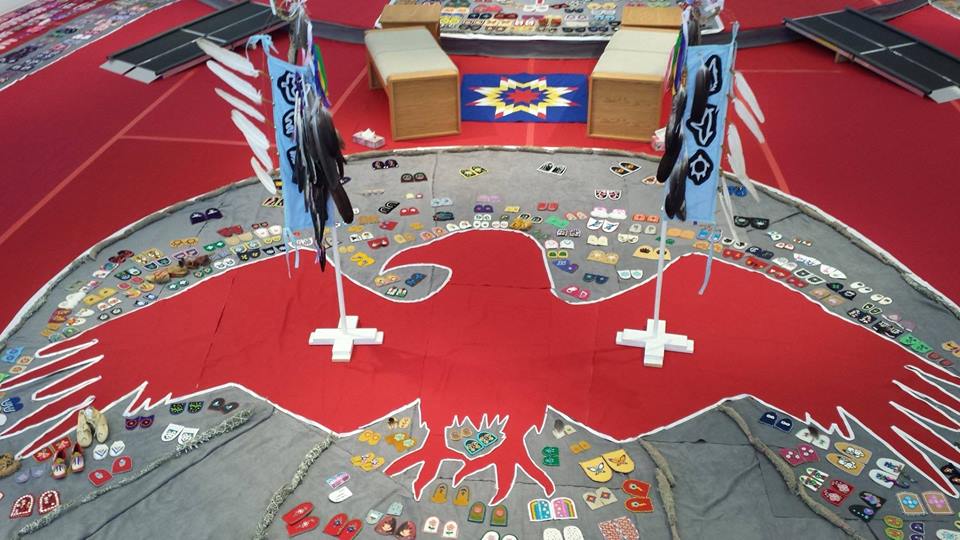
The project visited North Battleford in 2016. At the end of the final ceremony in Batoche, those who submitted vamps can ask to have them returned or offer them for a sacred fire.

The Walking with Our Sisters art installation. (submitted photo/Walking with Our Sisters North Battleford Facebook)

Wapass-Greyeyes helped create a shawl with multiple vamps to represent loved ones.

“This shawl will reflect this,” she said, adding it serves as a living document. “Don’t forget this. We can’t.”

Wapass-Greyeyes said she wanted to honour her niece who was murdered by her fiancé about 10 years ago.

Following the Batoche exhibition, the ceremonial shawl will be returned to North Battleford where it will be framed and displayed at the Allen Sapp Gallery.

“I am a woman who has been silenced for so many years, and now they can’t stop me from talking,” Wapass-Greyeyes said. She is also a residential school survivor herself, so the Walking with Our Sisters project has personal significance to her as well.

Leah Garven, curator/manager of Galleries for the City of North Battleford, said Walking with our Sisters travelled to 30 venues across North America. With each venue stop, each community donated a ceremonial object to the memorial.

“MMIW awareness is even more critical than ever,” she said. “The reasons that Indigenous women go missing is complex, and public awareness can be preventative in nature and it can provide support to the families who are hurting or grieving.”

North Battleford woman Ashley Morin was reported missing in July 2018. And, the court proceedings in the murder of another Indigenous woman, Tiki Laverdiere, have just started.

Garven said the urgency today is to support the Morin family in the search for their daughter, and to the Laverdiere family as they attend the court proceedings.

“This can be done through monetary donations, gifts, silent auction items, volunteering, walking alongside the family, attending court, making sandwiches, or by some of mankind’s simplest of deeds,” she said.

“I wanted to drive home a message to the perpetrators of these crimes that these women are not dispensable – that they are important and that they will be missed. And, that society is watching and protecting them,” Garven said.

angela.brown@jpbg.ca

On Twitter: @battlefordsnow